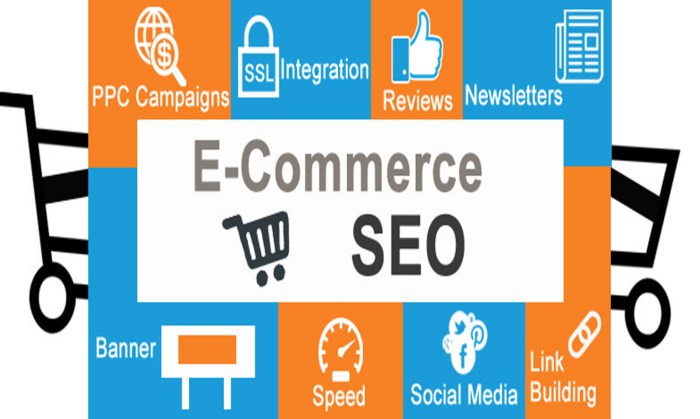
E-commerce SEO Services Boosting Online Sales

Seo ecommerce services commerce

In today’s digital landscape, a robust online presence is paramount for e-commerce success. E-commerce services provide the strategic framework to achieve this, transforming your online store from a hidden gem into a thriving marketplace. By optimizing your website for search engines, you unlock the potential to attract organic traffic, improve brand visibility, and ultimately drive significant sales growth.

This comprehensive guide explores the multifaceted nature of e-commerce , offering insights into effective strategies and best practices.

From technical optimization and on-page enhancements to off-page strategies and compelling content marketing, we’ll delve into each critical element. Understanding the nuances of e-commerce is crucial for navigating the competitive online environment and maximizing your return on investment. We’ll also explore the essential aspects of measuring and analyzing your performance to ensure continuous improvement and adaptation to the ever-evolving search landscape.

Off-Page Optimization for E-commerce

Off-page optimization is crucial for boosting an e-commerce website’s search engine rankings and driving organic traffic. Unlike on-page optimization, which focuses on website elements, off-page optimization involves activities performed outside your website to improve its online presence and authority. This includes building relationships, generating positive brand awareness, and ultimately, enhancing your site’s credibility in the eyes of search engines.

A strong off-page strategy complements on-page efforts, creating a powerful synergy for better search results.

Link Building for E-commerce Websites

Link building remains a cornerstone of successful . High-quality backlinks from reputable websites signal to search engines that your e-commerce site offers valuable content and products, thereby increasing its authority and ranking potential. Ethical link-building focuses on earning links naturally through valuable content creation and outreach, rather than employing manipulative tactics. Effective strategies include guest blogging on relevant industry websites, creating high-quality infographics and other shareable content, participating in online communities and forums, and building relationships with influencers.

Avoid black hat techniques such as buying links or participating in link schemes, as these can severely harm your website’s ranking. Focusing on building relationships with other websites in your niche is key; a collaborative approach is much more effective than attempting to acquire links through artificial means.

The Role of Social Media Marketing in Driving Traffic and Enhancing Brand Visibility

Social media marketing is an invaluable tool for e-commerce businesses. Platforms like Facebook, Instagram, Pinterest, and TikTok offer opportunities to engage directly with potential customers, build brand awareness, and drive traffic to your website. A well-executed social media strategy involves creating engaging content, running targeted advertising campaigns, and interacting with your audience. This fosters a sense of community around your brand and can significantly increase brand loyalty.

Consistent posting of high-quality images and videos, along with interactive content such as polls and quizzes, keeps your audience engaged and encourages sharing, leading to increased visibility and organic reach. Furthermore, social media platforms provide valuable data on customer preferences and behavior, which can inform your marketing and product development strategies.

Benefits of Local for E-commerce Businesses with Physical Locations

For e-commerce businesses with physical stores, local is essential for attracting customers in their geographical area. Optimizing your Google My Business profile, ensuring consistent NAP (Name, Address, Phone number) information across online directories, and encouraging customer reviews are key strategies. Local improves visibility in local search results, ensuring that customers searching for products or services in your area can easily find your business.

This can lead to increased foot traffic to your physical store and a boost in sales. Furthermore, positive online reviews can build trust and credibility with potential customers, increasing the likelihood of conversion.

Off-Page Optimization Strategies Categorized by Effectiveness and Cost

The effectiveness and cost of off-page optimization strategies vary considerably. Here’s a breakdown:

  • High Effectiveness, High Cost: Paid advertising campaigns (e.g., Google Ads, social media ads), influencer marketing collaborations.
  • High Effectiveness, Moderate Cost: Guest blogging on high-authority websites, creating high-quality, shareable content (infographics, videos), public relations outreach.
  • Moderate Effectiveness, Low Cost: Social media engagement, directory submissions, online forum participation, local business listing optimization.
  • Low Effectiveness, Low Cost: Commenting on blogs (if done ethically and relevantly), participating in low-authority forums.

Content Marketing for E-commerce

Content marketing is crucial for e-commerce success. It builds brand awareness, drives organic traffic, and ultimately boosts sales by establishing trust and authority within your niche. By creating high-quality, valuable content, you can attract potential customers who are actively searching for solutions you offer, converting passive browsers into loyal buyers. A well-executed content strategy significantly improves your search engine rankings, leading to increased visibility and a higher return on investment.

Creating Blog Posts that Attract Organic Traffic and Improve Search Rankings

Effective blog posts for e-commerce should focus on solving customer problems and addressing their needs. research is paramount; identifying relevant search terms allows you to create content that ranks highly in search engine results pages (SERPs). For example, an online retailer selling hiking boots could create blog posts on topics like “Choosing the Right Hiking Boots for Your Next Adventure,” “Best Hiking Boots for Beginners,” or “How to Care for Your Hiking Boots.” These posts should be comprehensive, informative, and engaging, incorporating high-quality images or videos to enhance user experience.

Internal linking to relevant product pages within the blog posts is essential for driving conversions. Optimizing meta descriptions and titles with relevant s further increases the chance of ranking higher in search results.

Examples of Successful E-commerce Content Marketing Campaigns

Many successful brands leverage content marketing effectively. For instance, Sephora’s blog features articles on makeup tutorials, skincare advice, and beauty trends, creating a community around their brand and driving traffic to their product pages. Similarly, Patagonia, an outdoor apparel company, publishes blog posts focusing on environmental sustainability and adventure stories, aligning with their brand values and attracting a loyal customer base.

These campaigns demonstrate that effective content marketing isn’t just about selling products; it’s about building relationships and providing value to the target audience. The success of these campaigns can be measured by increased website traffic, improved brand awareness, and ultimately, higher sales.

Creating Engaging Product Descriptions that Convert Visitors into Customers

Compelling product descriptions are essential for converting website visitors into customers. Instead of simply listing features, focus on highlighting the benefits and solving customer pain points. For example, instead of writing “This shirt is made of 100% cotton,” write “Experience ultimate comfort with our 100% cotton shirt, perfect for all-day wear.” Use strong action verbs and descriptive language to paint a vivid picture of the product in the customer’s mind.

Include customer reviews and testimonials to build trust and social proof. High-quality product images and videos further enhance the shopping experience. A/B testing different descriptions can help optimize conversion rates.

Developing a Content Calendar that Supports E-commerce Goals

A well-structured content calendar is crucial for maintaining consistency and achieving goals. It should Artikel topics, s, publication dates, and assigned writers or editors. Consider using a spreadsheet or dedicated content calendar software. Align your content calendar with your overall marketing strategy and goals. Prioritize topics that align with high-volume, low-competition s.

Regularly review and update the calendar based on performance data and emerging trends. This ensures your content remains relevant and effective in driving organic traffic and achieving your business objectives. For example, a monthly calendar might include blog posts, social media updates, email newsletters, and other content formats, all strategically planned to support your goals and seasonal promotions.

Measuring and Analyzing E-commerce Performance

Seo ecommerce services commerce

Understanding how your e-commerce strategy is performing is crucial for continued growth and profitability. Regularly measuring and analyzing key performance indicators (KPIs) allows you to identify what’s working, what’s not, and where to focus your efforts for optimal results. This involves tracking various metrics, analyzing the data, and using those insights to refine your approach.

Key Performance Indicators (KPIs) for E-commerce

Effective e-commerce relies on monitoring a range of KPIs to gauge success. These metrics provide a comprehensive view of your website’s performance and the impact of your strategies. Focusing on the right KPIs allows for data-driven decision-making and optimization.

KPI Description How to Track Interpretation
Organic Search Traffic The number of visitors arriving at your website from organic search results. Google Analytics, Search Console Higher traffic generally indicates improved performance, but needs to be correlated with conversions.
Conversion Rate The percentage of website visitors who complete a desired action (e.g., purchase, sign-up). Google Analytics, E-commerce platforms A higher conversion rate signifies effective and website design working together.
Average Order Value (AOV) The average amount spent per order. E-commerce platforms Increased AOV suggests successful upselling or cross-selling strategies.
Bounce Rate The percentage of visitors who leave your website after viewing only one page. Google Analytics A high bounce rate may indicate poor website design, irrelevant content, or technical issues.

Methods for Tracking Website Traffic, Conversions, and Other Relevant Metrics

Reliable tracking methods are essential for accurate assessment of your efforts. This involves using appropriate tools and configuring them correctly to capture relevant data.

Google Analytics remains a cornerstone for tracking website traffic, providing detailed insights into user behavior, including sources of traffic, pages visited, time spent on site, and conversion rates. Integrating Google Analytics with your e-commerce platform allows for comprehensive tracking of sales and revenue generated from organic search traffic. Google Search Console complements Google Analytics by offering data on how your website appears in Google search results, including rankings, click-through rates (CTR), and any technical issues affecting your site’s indexing.

Strategies for Analyzing Data to Identify Areas for Improvement

Analyzing your data isn’t just about looking at the numbers; it’s about understanding the story they tell. This involves identifying trends, patterns, and anomalies to pinpoint areas needing attention.

Regularly review your Google Analytics and Search Console data, paying close attention to trends over time. Compare your performance against industry benchmarks and competitors. Identify s with high search volume and low competition to target for improved organic rankings. Analyze your bounce rate and time on site to understand user engagement and identify areas for content improvement.

Investigate any sudden drops in traffic or conversions to identify potential issues, such as technical errors or algorithm updates.

Sample E-commerce Performance Report

A well-structured report simplifies the interpretation of complex data. This sample report demonstrates key metrics and their interpretations.

Metric Value Trend Interpretation
Organic Search Traffic 10,000 +15% (MoM) Significant increase indicating successful efforts.
Conversion Rate 2.5% +0.5% (MoM) Slight improvement, suggesting optimization opportunities remain.
Average Order Value (AOV) $75 – $5 (MoM) Requires further investigation; potential pricing or upselling issues.
Bounce Rate 40% -5% (MoM) Improvement, but still high; further website optimization needed.

Services Overview

E-commerce businesses rely heavily on search engine visibility to attract customers. A comprehensive strategy is crucial for success, and many businesses outsource this work to agencies or freelancers specializing in services. These services cover a broad range of activities, each designed to improve organic search rankings and drive targeted traffic to an online store. Understanding the different services available, their pricing structures, and the factors to consider when choosing a provider is key to making an informed decision.

Various services are offered, ranging from basic research and on-page optimization to advanced technical and link building campaigns. Agencies and freelancers typically package these services differently, catering to various business needs and budgets. Understanding these options allows e-commerce businesses to select the most suitable services to meet their specific goals.

Types of Services Offered

A wide array of services are available. These typically include research to identify relevant search terms, on-page optimization focusing on website content and structure, technical addressing website crawlability and indexability, off-page optimization involving link building and brand mentions, and content marketing strategies to create valuable and engaging content. Some agencies also offer local services for businesses targeting specific geographic areas, international for businesses expanding globally, and even specialized services like Amazon .

The specific services offered and their depth vary widely depending on the agency or freelancer.

Service Pricing Models

Different pricing models exist for services. Common models include hourly rates, project-based fees, retainer agreements, and performance-based pricing. Hourly rates charge clients for the time spent on tasks. Project-based fees involve a fixed price for a defined scope of work. Retainer agreements provide ongoing services for a monthly fee.

Performance-based pricing ties fees to the achievement of specific results, such as increased organic traffic or rankings. The choice of pricing model significantly impacts the overall cost and predictability of the investment. For example, a small e-commerce business might opt for a project-based approach for a website redesign, while a larger business might prefer a retainer agreement for ongoing support.

Factors to Consider When Selecting an Service Provider

Choosing the right service provider requires careful consideration of several factors. These include the agency’s experience and expertise in e-commerce , their understanding of the client’s industry and target audience, their approach to technical , their link-building strategies, their reporting and communication practices, and their pricing model. Client testimonials and case studies can offer valuable insights into the agency’s past performance.

It is crucial to assess the provider’s transparency and their ability to demonstrate a clear understanding of the client’s business objectives and the metrics used to track progress. For example, an agency demonstrating a strong understanding of Google Analytics and its application to e-commerce is highly desirable.

Importance of a Transparent and Data-Driven Approach in Services

A transparent and data-driven approach is essential for successful . Transparency involves clear communication about the strategies employed, the progress made, and any challenges encountered. A data-driven approach uses analytics to track performance, measure results, and inform future strategies. This includes using tools like Google Analytics, Google Search Console, and other relevant analytics platforms to monitor key performance indicators (KPIs) such as organic traffic, rankings, conversion rates, and bounce rates.

Regular reporting and analysis are crucial to ensure the strategy remains effective and aligned with the client’s goals. For example, consistent monitoring of rankings allows for timely adjustments to the strategy if necessary, maximizing the return on investment.

Mastering e-commerce is an ongoing process, requiring a blend of technical expertise, creative content strategy, and consistent monitoring. By implementing the strategies Artikeld in this guide, businesses can effectively optimize their online presence, attract targeted traffic, and convert visitors into loyal customers. Remember that a data-driven approach, coupled with a keen understanding of your target audience, is essential for long-term success in the dynamic world of e-commerce search engine optimization.

FAQ Resource

What is the difference between local and national for e-commerce?

Local targets customers in a specific geographic area, crucial for businesses with physical stores or serving a local market. National aims for broader reach across the country, focusing on s with nationwide appeal.

How long does it take to see results from e-commerce ?

Results vary depending on factors like website competition, strategy implementation, and the overall health of your website. You can expect to see some improvements within a few months, but significant results often take 6-12 months of consistent effort.

Should I hire an agency or manage my e-commerce in-house?

This depends on your budget, technical expertise, and available resources. Agencies offer specialized knowledge and dedicated resources, while in-house management offers greater control but requires significant time and expertise.

What is the role of schema markup in e-commerce ?

Schema markup helps search engines understand your website’s content better, leading to richer snippets in search results (e.g., star ratings, prices). This improved visibility can increase click-through rates.

Best SEO Services for Small Business

Seo services business small charlotte nc businesses

In today’s digital landscape, a strong online presence is crucial for small businesses to thrive. Effective search engine optimization () is no longer a luxury but a necessity, driving organic traffic and boosting visibility. This guide explores how small businesses can leverage the best services to achieve sustainable growth and reach their target audience efficiently.

We’ll delve into the characteristics of top-tier services, crucial performance indicators, and the essential services a reputable agency should offer. Furthermore, we’ll address budgeting considerations, methods for identifying reliable providers, and strategies for measuring the effectiveness of your investment. Understanding the nuances of on-page and off-page optimization, as well as avoiding common pitfalls, will be key takeaways.

Budgeting and Pricing for Small Business

Seo services business small charlotte nc businesses

Investing in for your small business can significantly boost your online visibility and drive more customers to your doorstep. However, understanding the cost involved is crucial for effective budgeting and planning. This section will clarify the pricing structures and factors influencing the overall cost of services for small businesses.

The cost of services varies greatly depending on several factors. It’s not a one-size-fits-all scenario, and prices can range from a few hundred dollars per month to several thousand, depending on the complexity of your needs and the scope of the work involved. Transparency and clear communication with your chosen agency are key to avoiding unexpected expenses.

Service Pricing Models

agencies typically employ various pricing models to cater to different client needs and budgets. Understanding these models helps you compare quotes effectively and choose the best fit for your business.

  • Hourly Rates: This model charges you based on the number of hours spent on your campaign. It’s often suitable for smaller, project-based tasks like research or on-page optimization. However, it can be difficult to predict the total cost upfront.
  • Project-Based Fees: This model involves a fixed price for a specific project, such as a website audit or a link-building campaign. It offers greater cost predictability than hourly rates, but it might not be suitable for ongoing maintenance.
  • Retainer Agreements: This is a monthly subscription model that covers ongoing services, including content creation, technical , link building, and reporting. It offers consistency and allows for continuous improvement of your website’s ranking. The monthly fee typically depends on the scope of services included.

Factors Influencing Service Prices

Several factors significantly impact the price of services. A clear understanding of these elements will help you make informed decisions when choosing an agency and managing your budget.

  • Website Size and Complexity: Larger websites with complex structures and extensive content generally require more time and effort to optimize, resulting in higher costs.
  • Industry Competition: Highly competitive industries require more aggressive strategies, leading to increased costs. For example, ranking for a competitive in the e-commerce space will typically cost more than ranking for a less competitive in a niche market.
  • Scope of Work: The extent of services included in your package directly affects the price. A comprehensive package including content creation, technical , link building, and ongoing reporting will naturally cost more than a basic package focusing solely on research and on-page optimization. A simple website audit might cost a few hundred dollars, while a comprehensive, multi-month campaign could run into thousands.

  • Agency Location and Experience: Agencies located in major metropolitan areas or with a proven track record of success often charge higher rates than smaller, less experienced agencies. The experience and expertise of the team are directly correlated to the pricing.

Identifying Reputable Service Providers

Finding the right agency for your small business can significantly impact your online success. A thorough vetting process is crucial to avoid costly mistakes and ensure a positive return on your investment. This involves careful consideration of several factors, from their experience and expertise to their communication style and pricing transparency.Choosing a reputable service provider requires a multi-faceted approach.

This includes evaluating their online presence, examining client testimonials, and directly engaging with potential agencies to assess their understanding of your business needs and their proposed strategies. Remember, a strong partnership built on trust and clear communication is essential for long-term success.

Vetting Potential Agencies

To effectively evaluate potential agencies, a structured approach is recommended. This involves reviewing their website, analyzing client testimonials, and conducting direct communication to ascertain their capabilities and suitability for your specific needs. Thorough due diligence minimizes the risk of selecting an unsuitable provider.

Checklist of Questions for Prospective Providers

Before committing to an agency, it’s essential to ask clarifying questions to understand their approach and ensure alignment with your business goals. These questions should cover their experience, strategies, reporting methods, and pricing structure. A comprehensive understanding of these factors allows for informed decision-making.

  • The agency’s experience in your specific industry and with similar-sized businesses should be explicitly stated.
  • A detailed explanation of their strategies, including on-page and off-page optimization techniques, should be provided.
  • The agency’s reporting process and the frequency of reports should be clearly defined.
  • Their pricing model, including any hidden fees or additional charges, should be transparent.
  • The agency’s client retention rate provides insight into client satisfaction and the longevity of their working relationships.

Comparing Different Approaches to Finding Reliable Services

Small business owners have various avenues to explore when searching for reliable services. Each approach offers unique advantages and disadvantages, requiring careful consideration to align with individual needs and preferences. For instance, online reviews can provide a broad overview, but referrals offer personalized insights, while industry directories offer curated lists of providers.

  • Online reviews on platforms like Google My Business, Yelp, and Clutch offer a broad spectrum of opinions from past clients. However, the authenticity and objectivity of these reviews should be critically assessed.
  • Referrals from trusted business contacts provide personalized recommendations based on direct experience. This approach offers valuable insights into the provider’s performance and reliability, but the pool of potential providers might be limited.
  • Industry directories, such as those maintained by professional associations, offer curated lists of verified providers. This method provides a degree of quality control but may not encompass all reputable agencies.

Understanding the Scope of Services

A comprehensive strategy involves much more than simply submitting your website to search engines. It’s a multifaceted approach designed to improve your website’s visibility and attract organic traffic. Understanding the scope of these services is crucial for small businesses aiming to maximize their online presence and return on investment. A successful strategy encompasses a range of activities, both on and off your website.

Effective isn’t a one-size-fits-all solution. The specific services needed will vary depending on your business goals, industry competitiveness, and current online presence. However, a well-rounded strategy will typically include several key components.

Core Components of a Comprehensive Strategy

The following elements form the foundation of a robust strategy. Each plays a vital role in enhancing your website’s ranking and driving organic traffic.

  • Research and Analysis: Identifying relevant s that your target audience uses to search for products or services like yours is paramount. This involves understanding search intent and competition.
  • On-Page Optimization: This involves optimizing individual web pages to rank higher and earn more relevant traffic in search engines. This includes title tags, meta descriptions, header tags, and image alt text.
  • Off-Page Optimization and Link Building: This focuses on building your website’s authority and credibility through backlinks from other reputable websites. This demonstrates to search engines that your site is a valuable resource.
  • Technical : This encompasses aspects like website speed, mobile-friendliness, sitemaps, and schema markup. Ensuring your website is technically sound is crucial for search engine crawlers to effectively index your content.
  • Content Marketing: Creating high-quality, engaging, and relevant content is essential for attracting and retaining visitors. This content should be optimized for relevant s and provide value to your audience.
  • Local (for local businesses): Optimizing your Google My Business profile, ensuring consistent NAP (Name, Address, Phone number) citations across the web, and building local citations are key elements for local businesses.
  • Reporting and Analysis: Regular monitoring of key performance indicators (KPIs) such as organic traffic, rankings, and conversion rates is vital to track progress and make data-driven adjustments to your strategy.

On-Page Optimization and Search Engine Rankings

On-page optimization refers to the practice of optimizing elements within your website’s code and content to improve its search engine rankings. This involves carefully crafting elements directly under your control. It’s about making your website easily understandable and relevant to search engines.

For example, using relevant s in your page titles, meta descriptions, and header tags (H1, H2, etc.) signals to search engines what your page is about. Optimizing image alt text with descriptive s helps both search engines and visually impaired users understand the content of your images. Furthermore, ensuring your website loads quickly and is mobile-friendly contributes significantly to a positive user experience, which search engines value.

Off-Page Optimization and Link Building for Small Businesses

Off-page optimization focuses on activities outside your website that influence your search engine rankings. The most crucial aspect of this is link building – earning high-quality backlinks from other reputable websites. These backlinks act as “votes of confidence,” signaling to search engines that your website is a trustworthy and authoritative source of information.

For small businesses, link building can be achieved through various methods, such as guest blogging on relevant websites, participating in online communities and forums, and building relationships with other businesses in your industry. Each backlink should be earned naturally and from a relevant website to avoid penalties from search engines. A high-quality backlink from a reputable source carries significantly more weight than many low-quality links from irrelevant sites.

Focusing on building a few strong, relevant links is far more effective than attempting to amass many low-quality links.

Measuring the Effectiveness of Services

Measuring the success of your campaign requires a robust tracking system and the ability to interpret the data it provides. This involves monitoring key performance indicators (KPIs) to understand how your efforts are impacting your website’s visibility and ultimately, your business goals. Effective measurement allows for data-driven adjustments to your strategy, ensuring optimal return on investment.Successful isn’t a guessing game; it’s a data-driven process.

By carefully tracking and analyzing relevant metrics, you can identify what’s working, what’s not, and make informed decisions to improve your campaign’s performance. This section Artikels a practical method for tracking key metrics and interpreting website analytics data to gain valuable insights.

Key Metrics for Monitoring Progress

A well-defined tracking system is crucial. You should monitor a combination of on-page and off-page factors to get a complete picture of your performance. Regularly reviewing these metrics allows you to identify trends and make necessary adjustments to your strategy.

  • Organic Search Traffic: This metric, tracked via Google Analytics, measures the number of visitors arriving at your website from organic search results. A steady increase indicates your efforts are driving more qualified traffic.
  • Rankings: Monitoring your website’s ranking for target s in search engine results pages (SERPs) is essential. Tools like SEMrush or Ahrefs can help track these rankings over time. Improvements here show that your is working to increase your visibility for important s.
  • Website Traffic Sources: Analyze the sources of your website traffic to understand which channels are contributing most to your organic growth. This helps to prioritize your efforts.
  • Bounce Rate: This metric represents the percentage of visitors who leave your website after viewing only one page. A high bounce rate could indicate issues with website content, user experience, or targeting. Addressing this can improve user engagement and signal search engines that your site is valuable.
  • Conversion Rate: This tracks the percentage of visitors who complete a desired action (e.g., making a purchase, filling out a form). Improved conversion rates show that your is not only driving traffic but also generating leads or sales.

Interpreting Website Analytics Data

Google Analytics is a powerful tool for understanding your website’s performance. It provides detailed information about website traffic, user behavior, and conversions. By analyzing this data in conjunction with your ranking data, you can gain a comprehensive understanding of your ‘s impact.For example, a significant increase in organic search traffic coupled with improved rankings for relevant terms strongly suggests your efforts are successful.

Conversely, a low conversion rate despite high organic traffic might indicate a problem with your website’s design or content, requiring further optimization.

Visual Representation of Performance Data

Visualizing data makes it easier to understand and communicate performance. Different chart types are suitable for different metrics.

  • Line Graph: Ideal for tracking changes in metrics over time, such as organic search traffic, rankings, and bounce rate. A line graph clearly shows trends and patterns in the data.
  • Bar Chart: Effective for comparing different metrics at a specific point in time, such as traffic from various sources or conversion rates across different landing pages.
  • Pie Chart: Useful for showing the proportion of traffic from different sources, providing a clear visual representation of the relative contribution of each channel.

For instance, a line graph showing organic search traffic increasing steadily over several months would visually demonstrate the positive impact of your campaign. Similarly, a bar chart comparing rankings before and after implementation could clearly illustrate the improvement in search engine visibility. A pie chart could show the breakdown of traffic sources, illustrating the dominant role of organic search compared to other sources.

Services

Small businesses often lack the resources and expertise to handle effectively in-house. Outsourcing to a reputable agency provides access to a range of specialized services designed to improve online visibility and drive targeted traffic. Understanding the different types of services available is crucial for making informed decisions and achieving optimal results.

Technical

Technical focuses on the website’s underlying structure and functionality to ensure search engines can easily crawl, index, and understand its content. This involves optimizing website speed, improving mobile-friendliness, fixing broken links, enhancing site architecture, and implementing schema markup. For small businesses, strong technical is foundational; a slow, poorly structured website will hinder even the best content marketing efforts.

A well-optimized website provides a solid base for all other activities, improving user experience and search engine rankings. For example, a small bakery website with slow loading times will frustrate potential customers and signal low quality to search engines, potentially resulting in lower rankings. Conversely, a fast, well-structured website will provide a positive user experience and improve search engine ranking possibilities.

Content

Content centers on creating high-quality, relevant, and engaging content that targets specific s and user search intent. This includes blog posts, articles, product descriptions, and other forms of written or visual content. For small businesses, content is vital for attracting organic traffic and establishing thought leadership within their industry. Effective content marketing builds brand awareness, drives conversions, and fosters customer loyalty.

A local florist, for instance, could create blog posts about seasonal flower arrangements or care tips, attracting customers searching for relevant information and establishing their expertise. This content should be optimized for relevant s, improving the chances of appearing in search results for those terms.

Local

Local focuses on optimizing a business’s online presence for local searches. This involves claiming and optimizing Google My Business profiles, building local citations (online directories), and encouraging online reviews. Local is crucial for small businesses with a physical location or serving a specific geographic area. It helps ensure they appear in local search results when potential customers search for relevant services or products nearby.

A pizza restaurant, for example, needs a strong local presence to appear in searches like “best pizza near me” or “pizza delivery [city name]”. Optimizing their Google My Business profile with accurate information, photos, and customer reviews is essential for this.

Common Mistakes to Avoid When Hiring Services

Choosing the right service provider can significantly impact a small business’s online success. Many businesses fall prey to common pitfalls, leading to wasted resources and disappointing results. Understanding these mistakes is crucial for making informed decisions and achieving a positive return on investment.Misleading or Unethical Practices and Their Consequences

Examples of Misleading or Unethical Practices

Several providers employ tactics that, while appearing effective in the short term, can severely harm a website’s long-term performance and search engine ranking. These practices often violate search engine guidelines and can result in penalties. For example, stuffing—overusing s to artificially inflate relevance—is a common unethical practice. Another example is the purchase of low-quality backlinks from unreliable sources, often referred to as “black hat” .

These backlinks can be easily identified by search engines as manipulative and lead to penalties, including de-indexing from search results. Finally, cloaking, which involves presenting different content to users and search engines, is a deceptive practice that violates search engine terms of service.

Potential Consequences of Choosing an Unreliable Provider

Selecting an unreliable provider can have severe repercussions for a small business. These consequences range from a complete waste of marketing budget to significant damage to online reputation. A provider employing black hat techniques may cause your website to be penalized by search engines, leading to a significant drop in organic traffic. This can translate into lost revenue and decreased brand visibility.

Furthermore, some providers make unrealistic promises of quick results, which often lead to disappointment and frustration. In some cases, businesses may experience data breaches or other security issues if they choose a provider with inadequate security measures. Finally, the lack of transparency and communication from unreliable providers can leave businesses in the dark about the progress of their campaigns.

Avoiding Pitfalls When Selecting and Working with an Agency

Careful selection and ongoing monitoring are essential to avoid common pitfalls. Before engaging an agency, thoroughly research their experience, client testimonials, and strategies. Look for providers who emphasize white hat techniques, transparency, and measurable results. Avoid agencies that guarantee top rankings or promise unrealistic results in a short time frame. A reputable provider will focus on long-term, sustainable strategies rather than quick fixes.

Regularly review reports and communicate openly with your provider to track progress and address any concerns. Establishing clear expectations and milestones from the outset is crucial for a successful partnership. Consider requesting case studies from past clients to assess the provider’s success rate and the quality of their work. Finally, ensure the contract includes clear deliverables, payment terms, and a process for resolving disputes.

Ultimately, selecting the right services is an investment in your small business’s future. By carefully considering the factors discussed – from budgeting and vetting agencies to tracking performance metrics – you can confidently navigate the world of and unlock the immense potential of organic search. Remember, a well-executed strategy is not just about higher rankings; it’s about building a sustainable online presence that drives consistent growth and strengthens your brand.

Essential FAQs

What is the average cost of services for small businesses?

Costs vary widely depending on factors like website size, industry competitiveness, and the scope of work. Expect a range from a few hundred to several thousand dollars per month.

How long does it take to see results from ?

Results are not immediate. It typically takes several months of consistent effort to see significant improvements in organic search rankings and traffic. Patience and persistence are key.

What are some red flags to watch out for when hiring an agency?

Beware of agencies guaranteeing top rankings, using black-hat techniques (like stuffing), or lacking transparency in their methods. Thorough research and due diligence are essential.

Should I hire an agency or manage in-house?

The best approach depends on your budget, technical expertise, and available resources. Outsourcing to an agency often provides specialized skills and time savings, while in-house management offers greater control.

Monthly SEO Services Packages A Comprehensive Guide

Packages

Monthly service packages offer businesses a strategic and sustainable approach to improving their online visibility. Unlike one-time fixes, these packages provide ongoing optimization, ensuring consistent growth and higher search engine rankings. This guide delves into the various aspects of monthly packages, from understanding their core components to measuring their success and addressing common challenges.

We will explore different package tiers, their pricing structures, and the key features that contribute to their effectiveness. We’ll also examine the ideal client profile, discuss the evolution of services, and provide practical advice for selecting and collaborating with an provider. Ultimately, this guide aims to equip businesses with the knowledge to make informed decisions about investing in monthly services.

Defining Monthly Service Packages

Monthly service packages offer businesses a structured approach to improving their online visibility and organic search rankings. These packages bundle various services into tiered offerings, catering to different budgets and business needs. Understanding the components and variations within these packages is crucial for selecting the right fit.

The core components of a typical monthly package usually include research, on-page optimization (including title tags, meta descriptions, and content optimization), off-page optimization (like link building and citation building), technical (website audits and site speed improvements), and reporting and analytics. The extent of each service and the overall strategy employed will vary depending on the package level.

Differences Between Package Tiers

Basic, premium, and enterprise-level packages differ significantly in the scope of services, the level of expertise involved, and the volume of work undertaken. A basic package typically focuses on foundational tasks, providing a solid base for organic growth. Premium packages expand on this foundation, incorporating more advanced strategies and a higher level of dedicated support. Enterprise-level packages are tailored to larger businesses with complex needs, often including dedicated account managers and customized solutions.

Examples of Monthly Service Packages

The following table illustrates potential pricing and features for different package tiers. Note that these are examples and actual pricing may vary depending on factors such as website size, industry competitiveness, and specific requirements.

Package Name Price Features Target Audience
Basic $500 – $1000 research (50 s), on-page optimization (10 pages), basic link building (5 links per month), monthly reporting Small businesses with limited budgets, new websites
Premium $1500 – $3000 research (150 s), on-page optimization (30 pages), advanced link building (15-20 high-quality links per month), technical audit, monthly reporting and strategy calls Established businesses looking for significant growth, medium-sized websites with established content
Enterprise $5000+ Comprehensive research, on-page and off-page optimization across the entire website, advanced technical , dedicated account manager, competitive analysis, monthly reporting and strategy sessions, custom strategies tailored to specific business goals Large businesses with high-volume websites, complex needs, and significant marketing budgets

Benefits of Monthly Services

Prunderground

Choosing a monthly service offers significant advantages over one-time fixes. Consistent, strategic optimization builds a strong foundation for long-term online success, unlike short-term campaigns that offer only temporary boosts. Monthly services allow for continuous improvement, adaptation to algorithm changes, and a deeper understanding of your website’s performance, ultimately leading to sustained growth and improved search engine rankings.Monthly packages contribute significantly to long-term website growth and increased online visibility by fostering a continuous improvement cycle.

Unlike one-time efforts, which provide a short-term bump, monthly services allow for consistent monitoring, analysis, and adjustments. This ensures your website remains relevant, competitive, and visible to your target audience over an extended period. Regular updates to content, technical aspects, and link building strategies, all part of a comprehensive monthly package, ensure sustained momentum and ongoing improvements in organic search performance.

Sustained Organic Growth Through Consistent Optimization

Regular efforts, delivered through a monthly service, lead to far more significant and lasting results than one-off projects. A monthly plan allows for consistent monitoring of key performance indicators (KPIs), enabling proactive adjustments based on real-time data. This proactive approach allows specialists to identify and address issues promptly, preventing potential setbacks and maximizing the effectiveness of ongoing optimization strategies.

The cumulative effect of these consistent improvements is substantial and far outweighs the benefits of any single, isolated campaign.

Case Studies Illustrating the Impact of Sustained Strategies

The following examples highlight the positive impact of sustained strategies implemented through monthly service packages. These are not hypothetical scenarios but reflect real-world results achieved by clients who opted for ongoing support.

  • Client A: A small e-commerce business experienced a 40% increase in organic traffic and a 25% rise in sales within 12 months of starting a monthly program. This was achieved through a combination of optimization, content creation, and technical improvements consistently implemented over the year. The improvement was directly correlated to consistent, monthly adjustments to the strategy based on performance data.

  • Client B: A local bakery saw a significant increase in local search visibility after six months of monthly services. The focus was on local optimization, including Google My Business optimization and citation building. The result was a 60% increase in foot traffic and a 30% increase in online orders. Consistent updates and monitoring of local signals were key to this success.

  • Client C: A national law firm experienced a 30% increase in qualified leads within nine months of initiating a monthly package. This was achieved through a targeted content strategy focused on long-tail s relevant to their legal practice areas. The consistent creation and optimization of high-quality, informative content was a critical factor in achieving these results.

Measuring the Success of Monthly Services

Packages

Tracking the effectiveness of your monthly services is crucial for demonstrating value to clients and optimizing your strategies. Regular monitoring of key performance indicators (KPIs) provides insights into the progress of your efforts and allows for data-driven adjustments. This section details how to measure success, interpret data, and present findings effectively.Key Performance Indicators (KPIs) for SuccessUnderstanding which metrics to track is paramount.

Focusing on the right KPIs allows for a clear picture of progress and identifies areas needing improvement. Different KPIs will be relevant depending on the client’s specific goals, but some key metrics consistently provide valuable insights.

Website Traffic Analysis

Analyzing website traffic data provides a fundamental understanding of how your efforts are impacting the visibility and reach of your client’s website. This includes examining the source of traffic, user behavior, and the overall volume of visits. A significant increase in organic traffic, particularly from targeted s, directly indicates the effectiveness of your strategies. This data can be obtained through platforms like Google Analytics.

Examining the bounce rate, average session duration, and pages per session provides additional insights into user engagement and experience. A lower bounce rate and higher average session duration typically signify improved content quality and relevance.

Ranking Analysis

Tracking rankings is essential for measuring the impact of your efforts on search engine visibility. Monitoring the positions of targeted s in search engine results pages (SERPs) demonstrates the effectiveness of your on-page and off-page optimization strategies. Tools like SEMrush, Ahrefs, or Google Search Console can be used to track rankings. A consistent improvement in rankings, particularly for high-volume s, suggests successful optimization.

Conversion Rate Optimization

Conversion rate optimization (CRO) focuses on turning website visitors into customers or leads. Tracking conversion rates allows you to assess the effectiveness of your efforts in driving valuable actions. This could involve tracking form submissions, purchases, or newsletter sign-ups. A higher conversion rate indicates that your strategy is successfully attracting and engaging the right target audience.

Backlink Profile Analysis

Analyzing the backlink profile of a website helps understand its authority and reputation within the online landscape. A strong backlink profile, characterized by high-quality links from reputable websites, contributes significantly to higher search engine rankings. Tools like Ahrefs and SEMrush provide comprehensive backlink data, allowing you to track the growth and quality of backlinks over time. An increase in high-quality backlinks indicates the success of your off-page optimization strategies.

Presenting Performance Data to Clients

Clear and concise presentation of data is crucial for demonstrating the value of your services. Visually appealing charts and graphs significantly enhance understanding and impact.

Data Visualization Techniques

Using charts and graphs to present performance data is crucial for clear communication. Here are some examples:

Line graph showing ranking changes over time: This graph displays the position of specific s in SERPs over a given period (e.g., monthly). The X-axis represents time, and the Y-axis represents the rank. A rising line indicates improvement in ranking, while a falling line suggests a decline. Multiple lines can be used to compare the performance of different s.

Bar chart comparing website traffic sources: This chart visually represents the proportion of website traffic from different sources (e.g., organic search, social media, paid advertising). The X-axis lists the traffic sources, and the Y-axis shows the volume of traffic. This chart helps clients understand the contribution of organic search traffic to their overall website traffic.

Pie chart showing the distribution of website traffic by device: This chart displays the percentage of website traffic coming from different devices (e.g., desktop, mobile, tablet). The chart is divided into slices, each representing a device type and its corresponding percentage of traffic. This helps clients understand the user experience across different devices.

Table showing key metrics and their changes over time: A table can effectively display various key metrics (e.g., organic traffic, rankings, conversion rates) and their changes over a specific period. This provides a comprehensive overview of performance.

Common Challenges in Monthly Services

Providing consistent, high-quality monthly services requires navigating a dynamic landscape filled with potential hurdles. Success hinges on understanding these challenges and proactively developing strategies to mitigate their impact. Failing to address these issues can lead to unmet client expectations and ultimately, the failure of the campaign.Algorithm updates, intense competition, and managing client expectations are among the most significant obstacles faced.

Effectively addressing these challenges demands a proactive approach, combining technical expertise with strong client communication.

Algorithm Updates

Google’s algorithm updates are frequent and can significantly impact search rankings. A previously effective strategy may suddenly become less effective, requiring rapid adaptation. For example, a major algorithm update focusing on content quality might negatively affect websites relying on stuffing, leading to a drop in organic traffic. To overcome this challenge, a robust strategy should prioritize high-quality, original content that meets user search intent.

Regular monitoring of Google’s search quality guidelines and staying updated on algorithm changes through reputable sources is essential. Furthermore, diversifying strategies beyond relying solely on specific ranking factors can help mitigate the risk associated with algorithm updates.

Competition

The competitive landscape of is intense. Businesses operate in highly competitive niches, often facing strong competition from established players with significant resources. A successful strategy must account for this competition. For instance, a small business competing against a multinational corporation will need a highly targeted and efficient strategy to achieve visibility. To counter this, a well-defined strategy focusing on long-tail s and a strong focus on building high-quality backlinks from reputable sources can improve competitiveness.

Regular competitor analysis and adapting the strategy based on competitor performance are crucial for maintaining a competitive edge.

Client Expectations

Managing client expectations is paramount. is a long-term strategy, and results are not always immediate. Clients often expect quick, significant improvements in rankings and traffic. This discrepancy between the reality of and client expectations can lead to frustration and dissatisfaction. For example, a client might expect to see a significant increase in traffic within the first month, which is often unrealistic.

To address this, setting realistic expectations from the outset through transparent communication is vital. Regular reporting with clear metrics, explanations of the process, and realistic timelines can help maintain client trust and satisfaction. Clearly outlining the limitations of and potential unexpected outcomes is also crucial for managing expectations effectively.

Transparency and Communication

Open and honest communication with clients is crucial for building trust and managing expectations. Regular reporting on performance, using easily understandable metrics, is essential. For instance, providing monthly reports showing changes in organic traffic, rankings, and backlink profiles allows clients to see the progress and understand the efforts being made. When challenges arise, such as a significant algorithm update impacting rankings, proactively communicating the situation and outlining the steps being taken to address it is vital for maintaining client confidence.

Transparency builds trust and helps clients understand the complexities and nuances of , fostering a collaborative and successful partnership.

Investing in a well-structured monthly service package is a strategic decision that can significantly impact a business’s online success. By understanding the components of effective packages, tailoring them to specific business needs, and effectively measuring their results, businesses can unlock substantial growth and maintain a competitive edge in the digital landscape. Remember to choose a provider that prioritizes transparency, communication, and data-driven strategies for optimal results.

Frequently Asked Questions

What is the difference between on-page and off-page ?

On-page focuses on optimizing elements within your website (content, meta descriptions, etc.), while off-page involves building your website’s authority through external factors (backlinks, social media mentions).

How long does it take to see results from monthly services?

Results vary depending on factors like your website’s current state, competition, and the scope of the strategy. Generally, you can expect to see noticeable improvements within 3-6 months.

What KPIs should I track to measure success?

Key performance indicators (KPIs) include organic traffic, rankings, website conversions, and backlink profile. Your specific KPIs will depend on your business goals.

Can I cancel my monthly service at any time?

Most providers offer flexible cancellation policies, but it’s crucial to review the terms and conditions of your contract.

SEO Content Writing Services Boosting Online Visibility

Seo writing services professional writer service credible boost looking

Unlocking the power of online visibility requires a strategic approach, and content writing services are at the forefront of this digital revolution. This comprehensive guide delves into the intricacies of crafting compelling, search-engine-optimized content that drives organic traffic and enhances brand awareness. We’ll explore the core components, benefits, and processes involved in creating effective content, demonstrating how businesses can leverage this powerful strategy to achieve their marketing objectives.

From understanding the fundamental differences between content writing and general content creation to mastering on-page and off-page optimization techniques, we’ll cover the essential elements needed to succeed in today’s competitive online landscape. We’ll also examine the broader context of services, highlighting the synergy between content writing and other crucial aspects of search engine optimization.

Defining Content Writing Services

content writing services encompass the creation and optimization of written content to improve a website’s ranking in search engine results pages (SERPs). This involves strategically incorporating relevant s and phrases to attract organic traffic and enhance online visibility. The ultimate goal is to drive more qualified leads and conversions for businesses. content writing goes beyond simply crafting engaging text; it requires a deep understanding of search engine algorithms, user behavior, and the competitive landscape.

Effective content writing services deliver results by aligning content strategy with business objectives.

Core Components of Content Writing Services

The core components of content writing services involve research, on-page optimization, off-page optimization, and content strategy. research identifies relevant terms users search for, informing content creation. On-page optimization focuses on optimizing individual web pages for specific s, including title tags, meta descriptions, header tags, and image alt text. Off-page optimization involves building high-quality backlinks from other reputable websites.

A robust content strategy guides the creation of diverse content formats to address various user needs and search intents.

Types of Content Created Under Content Writing Services

Various content formats are employed within content writing services to reach a broader audience and cater to diverse search intents. These include blog posts, articles, website copy, product descriptions, infographics, videos, and social media content. Each format serves a specific purpose, from building brand awareness to driving direct sales. For example, blog posts can establish thought leadership, while product descriptions directly influence purchasing decisions.

Key Differences Between Content Writing and General Content Writing

While both content writing and general content writing aim to engage readers, their approaches differ significantly. General content writing focuses primarily on creating compelling and informative content, without necessarily considering search engine optimization. content writing, on the other hand, integrates research, on-page optimization, and other techniques to enhance search engine rankings. The primary difference lies in the strategic use of s and the optimization for search engines.

General content writing prioritizes readability and engagement, while content writing balances these with search engine optimization.

Examples of Successful Content Writing Strategies

The effectiveness of content writing strategies varies across industries. A successful approach requires tailoring the strategy to the specific industry, target audience, and business goals. The following table showcases examples across different sectors:

Industry Content Type Strategy Results
E-commerce (Clothing) Product Descriptions, Blog Posts (Style Guides) research targeting specific clothing items and styles; use of high-quality product images with optimized alt text; creation of engaging blog content around fashion trends and styling tips. Increased organic traffic, higher conversion rates, improved brand awareness.
Finance (Investment Banking) White Papers, Case Studies, Webinars Targeting long-tail s related to specific financial services; creating in-depth, authoritative content demonstrating expertise; building backlinks from relevant financial publications. Enhanced credibility, lead generation, increased brand authority.
Healthcare (Dentistry) Blog Posts (Oral Hygiene Tips), FAQs, Local Focusing on local s and search terms related to dental services in the local area; providing valuable information on oral health; optimizing Google My Business profile. Increased local search visibility, more patient appointments, improved online reputation.
Technology (Software) Blog Posts (Tutorials, Product Updates), Case Studies, Video Tutorials Using a mix of content formats to address different user needs; focusing on s related to specific software features and functionalities; optimizing for long-tail s and user intent. Higher website traffic, increased user engagement, improved lead generation.

The Value Proposition of Content Writing Services

Seo writing guide awai

Investing in professional content writing services offers businesses a significant competitive advantage in the digital landscape. By strategically crafting content optimized for search engines, businesses can attract more organic traffic, build brand awareness, and ultimately drive conversions and revenue growth. This approach differs from traditional marketing methods by focusing on attracting customers actively seeking solutions, rather than relying on broader, less targeted advertising campaigns.Businesses gain several key benefits from utilizing content writing services.

Firstly, improved organic search engine rankings lead to increased website visibility and higher traffic volume. This translates directly into more potential customers engaging with your brand. Secondly, well-crafted content establishes your business as a thought leader in your industry, building trust and credibility with your target audience. This enhanced brand reputation can lead to increased customer loyalty and advocacy.

Finally, content writing contributes to a stronger online presence, positioning your business favorably against competitors. This comprehensive approach ensures a sustainable and cost-effective marketing strategy.

Increased Organic Traffic and Website Visibility

content writing focuses on creating high-quality, -rich content that aligns with search engine algorithms. This results in improved search engine rankings for relevant s, driving significant increases in organic website traffic. For example, a small e-commerce business specializing in handcrafted jewelry saw a 300% increase in website traffic within six months of implementing a comprehensive content strategy, resulting in a substantial boost in sales.

This increase was primarily driven by improved organic rankings for target s related to their products.

Return on Investment (ROI) of Content Writing Services

The ROI of content writing services can be substantial, though it’s not always immediate. A successful strategy requires consistent effort and a long-term perspective. However, the long-term benefits far outweigh the initial investment. Consider a hypothetical scenario: a business invests $5,000 in content writing services over a year. This leads to a 20% increase in organic traffic, which in turn generates an additional $20,000 in revenue.

This represents a 400% return on investment, demonstrating the potential for significant financial gains. While results vary depending on the industry, market competitiveness, and the quality of the service, numerous case studies showcase impressive ROI.

Content Writing Compared to Other Digital Marketing Strategies

While other digital marketing strategies like paid advertising (PPC) and social media marketing are valuable, content writing offers a unique and sustainable advantage. PPC campaigns, while effective for quick results, require ongoing financial investment. Social media marketing can build brand awareness, but organic reach is often limited. content writing, however, builds organic, long-term traffic and establishes a strong online presence without constant financial expenditure.

It complements other strategies, creating a holistic and powerful marketing approach. The sustained, organic traffic generated by provides a more cost-effective and stable foundation for online growth compared to the fluctuating nature of PPC or the limited reach of organic social media.

Marketing Message Highlighting the Value Proposition

“Stop paying for clicks. Start owning your search results. Our content writing services deliver sustainable growth by attracting qualified organic traffic, building brand authority, and driving conversions. Let us transform your online presence and achieve lasting results.”

Services

, or Search Engine Optimization, encompasses a broad range of strategies and tactics aimed at improving a website’s visibility and ranking in search engine results pages (SERPs). While content writing is a crucial component, it’s only one piece of a larger, more complex puzzle. Understanding the full scope of services is vital for achieving comprehensive online success. content writing focuses specifically on creating high-quality, -rich content that resonates with both search engines and the target audience.

However, other vital aspects contribute to a successful strategy.

The Range of Services

A comprehensive strategy typically involves several interconnected services. These include, but are not limited to, technical , on-page optimization, off-page optimization (like link building), local , and ongoing monitoring and reporting. Technical focuses on the website’s underlying structure and functionality to ensure search engines can easily crawl and index its content. On-page optimization involves optimizing individual web pages with relevant s and meta descriptions.

Off-page optimization builds the website’s authority and credibility through activities like link building. Local targets local searches and improves visibility for businesses operating within a specific geographical area. Finally, consistent monitoring and reporting track the effectiveness of efforts and allow for adjustments as needed.

Comparison of Services

content writing, while essential, differs significantly from other services. Unlike technical , which focuses on the website’s technical infrastructure, content writing concentrates on creating engaging and informative content. It differs from link building, which focuses on acquiring backlinks from reputable websites to improve domain authority. While all three are interconnected and contribute to overall success, their approaches and deliverables are distinct.

For example, technical might involve fixing broken links and improving site speed, while link building aims to secure high-quality backlinks from relevant websites, and content writing produces valuable content that attracts both users and search engines.

Key Skills and Expertise for Comprehensive Services

Providing comprehensive services requires a multifaceted skillset. This includes a strong understanding of search engine algorithms, research techniques, content creation and optimization strategies, technical website analysis, link building tactics, data analysis capabilities, and project management skills. Expertise in specific areas like HTML, CSS, and analytics platforms like Google Analytics and Google Search Console is also highly beneficial.

A successful professional needs to be both creative and analytical, combining writing talent with technical expertise.

The Importance of Data Analysis in Strategy and Content Creation

Data analysis is paramount to a successful strategy. By analyzing website traffic data, rankings, backlink profiles, and user behavior, professionals can gain valuable insights into what’s working, what’s not, and how to optimize their strategies accordingly. This data-driven approach informs content creation by highlighting the most relevant s and topics to target. For instance, analyzing search query data can reveal what users are searching for, guiding content creation towards topics with high search volume and low competition.

Tracking rankings helps assess the effectiveness of efforts and identify areas for improvement.

Visual Aspects of Content Writing Services

Seo writing services professional writer service credible boost looking

High-quality visuals are no longer optional in successful content strategies; they are essential. Engaging visuals significantly improve user experience, leading to increased time on page, lower bounce rates, and ultimately, better search engine rankings. This section explores the crucial role of images in optimizing content for search engines and enhancing overall performance.

High-Quality Images Enhance Content

Compelling visuals break up large blocks of text, making your content more digestible and appealing to readers. Images can illustrate complex concepts, add emotional depth, and simply make your content more visually interesting. High-resolution, professionally-shot images convey credibility and professionalism, contributing to a positive brand image. This, in turn, influences user trust and engagement, which are key factors for search engine algorithms.

The improved user experience directly translates into better performance.

Image Optimization for Search Engines

Optimizing images for search engines involves more than just uploading a pretty picture. Search engines cannot “see” images in the same way humans do; they rely on metadata to understand their context. This involves using descriptive file names (e.g., “-content-writing-services.jpg” instead of “image1.jpg”), adding alt text that accurately describes the image content for visually impaired users and search engine crawlers, and compressing images to reduce page load time without sacrificing quality.

Proper image optimization ensures that search engines can correctly index and rank your content, leading to increased visibility in image search results.

Visuals Improve User Engagement and Content Performance

Studies consistently show a strong correlation between the use of high-quality visuals and improved user engagement metrics. Infographics, for example, can present complex data in an easily understandable and visually appealing format, leading to increased comprehension and knowledge retention. Videos can add a personal touch, increasing viewer engagement and fostering a sense of connection with your brand. Even simple, well-chosen images can dramatically improve the overall aesthetic appeal of your content, making it more shareable on social media platforms and increasing its overall reach.

This translates into increased organic traffic and improved search engine rankings.

Image Description Examples

Here are descriptions for three different images that would be suitable for an article about content writing services:

Image 1: A diverse group of professionals, smiling and collaborating around a table littered with laptops, notebooks, and a whiteboard filled with s and content strategy diagrams. The image is brightly lit and conveys a sense of teamwork and creative energy. The overall feel is professional yet approachable, emphasizing the collaborative nature of effective content creation.

Image 2: A close-up shot of a hand typing on a laptop keyboard, with a partially visible screen displaying a well-structured article with relevant s highlighted. The focus is on the act of content creation, emphasizing the meticulous process involved in producing high-quality content. The image should feel professional and clean, conveying precision and attention to detail.

Image 3: An infographic depicting the stages of an content writing process, from research and content planning to publishing and performance analysis. The infographic uses a clean, modern design with clear icons and concise text. This image effectively communicates the complexity of the service in a visually appealing and easily digestible format. It should employ a vibrant color palette to maintain interest.

In conclusion, investing in professional content writing services offers businesses a significant competitive advantage in the digital marketplace. By strategically crafting high-quality, -rich content, businesses can improve their search engine rankings, attract targeted audiences, and ultimately achieve a greater return on investment. Understanding the intricacies of content writing, from initial research to ongoing optimization, is crucial for long-term online success.

This guide provides a solid foundation for understanding and implementing this vital marketing strategy.

Expert Answers

What is the difference between content writing and copywriting?

While both involve writing, content writing prioritizes search engine optimization, focusing on s and user intent to rank higher in search results. Copywriting focuses primarily on persuasion and driving conversions.

How long does it take to see results from content writing?

Results vary depending on factors like competition and website authority. It can take several months to see significant improvements in organic search rankings.

How much does content writing cost?

Pricing depends on factors such as content length, difficulty, and the writer’s experience. It’s best to request quotes from different providers.

Do I need to provide s for my content?

While providing s is helpful, a good content writer will conduct thorough research to identify the most relevant and effective terms for your target audience.

Professional SEO Services Elevating Your Online Presence

Seo driven pave proprietary

In today’s digital landscape, a strong online presence is paramount for business success. Professional services offer a strategic advantage, transforming how potential customers discover your brand. By leveraging expertise in search engine optimization, businesses can significantly improve their visibility, attract targeted traffic, and ultimately drive growth. This exploration delves into the multifaceted world of professional , examining its core components, diverse strategies, and ethical considerations.

From understanding client needs and developing tailored strategies to employing advanced techniques and meticulously tracking results, professional is a dynamic process. This guide provides a comprehensive overview, empowering businesses to make informed decisions about optimizing their online presence and achieving lasting success in the competitive digital marketplace.

Defining Professional Services

Professional services encompass a comprehensive strategy designed to improve a website’s visibility and ranking in search engine results pages (SERPs). Unlike DIY or amateur approaches, professional services leverage advanced tools, data analysis, and expertise to achieve measurable and sustainable results. This ensures a website is optimized not only for search engines but also for user experience, leading to increased organic traffic and ultimately, business growth.Professional services go beyond basic stuffing or link building.

They involve a multifaceted approach encompassing technical , on-page optimization, off-page optimization, and ongoing monitoring and analysis.

Core Components of Professional Services

Professional services are built upon several key pillars. These include a thorough website audit to identify technical issues and areas for improvement, research to determine the most relevant and effective search terms, on-page optimization focusing on content quality, meta descriptions, and internal linking, and off-page optimization strategies such as link building and social media engagement. Further, consistent monitoring and reporting provide crucial insights into campaign performance and allow for necessary adjustments.

Data-driven decision making is at the core of a professional strategy.

The Value Proposition of Hiring Professionals

Hiring professional services offers several significant advantages. Professionals possess in-depth knowledge of search engine algorithms and best practices, ensuring optimized campaigns that align with the latest updates. They have access to advanced tools and analytics that provide detailed insights into website performance and user behavior. Furthermore, professionals can dedicate the necessary time and resources to manage complex strategies, freeing up businesses to focus on their core operations.

A dedicated team can handle the complexities of algorithm changes and evolving search engine landscape. The return on investment (ROI) from a professional strategy often significantly surpasses that of DIY attempts. For example, a small business might see a 50% increase in organic traffic within six months of engaging a professional firm, leading to a substantial increase in leads and sales.

This contrasts sharply with the inconsistent and often minimal results seen with DIY efforts.

Comparison of Professional Services vs. DIY Methods

Feature Professional Services DIY Methods
Expertise & Knowledge Deep understanding of best practices, algorithms, and tools. Limited knowledge, reliance on outdated or inaccurate information.
Time Commitment Dedicated team managing efforts consistently. Significant time investment required from business owners or employees, potentially detracting from core business tasks.
Tools & Technology Access to advanced analytics, software, and data-driven insights. Limited access to professional tools, relying on free or basic options.
Results & ROI Measurable results, significant ROI through increased organic traffic and conversions. Inconsistent results, potentially low or no ROI, and wasted time and resources.

Types of Professional Services Offered

Professional services encompass a wide range of strategies designed to improve a website’s visibility and ranking in search engine results pages (SERPs). These services are typically categorized to address different aspects of online optimization, allowing businesses to tailor their approach to specific needs and goals. Understanding these categories is crucial for selecting the right services and maximizing return on investment.

Professional services are often grouped into three main categories: Technical , Content , and Off-Page . Each category involves distinct tasks and techniques, and a comprehensive strategy usually incorporates elements from all three.

Technical Services

Technical focuses on the website’s underlying structure and functionality, ensuring search engines can easily crawl, index, and understand its content. This often involves addressing technical issues that can hinder website performance and visibility.

  • Website audit: Identifying technical issues like broken links, slow loading speed, and crawl errors.
  • XML sitemap creation and submission: Helping search engines discover and index all website pages.
  • Robots.txt optimization: Controlling which pages search engines can access.
  • Schema markup implementation: Enhancing search engine understanding of website content.
  • Mobile optimization: Ensuring the website is responsive and user-friendly on all devices.
  • Page speed optimization: Improving website loading time through various techniques.
  • HTTPS implementation: Securing the website with an SSL certificate.

Content Services

Content focuses on creating high-quality, relevant, and engaging content that satisfies user search intent and ranks well in search results. This involves research, content optimization, and content promotion.

  • research: Identifying relevant s with high search volume and low competition.
  • On-page optimization: Optimizing website content and meta descriptions for target s.
  • Content creation: Developing high-quality, engaging, and informative content.
  • Content strategy: Developing a plan for creating and distributing content.
  • Content promotion: Sharing content on social media and other channels.
  • Internal linking: Connecting related pages within the website to improve navigation and .

Off-Page Services

Off-page focuses on building the website’s authority and reputation through activities outside the website itself. This primarily involves link building and brand mentions.

  • Link building: Acquiring high-quality backlinks from reputable websites.
  • Guest blogging: Creating and publishing content on other websites.
  • Social media marketing: Promoting the website and its content on social media platforms.
  • Online reputation management: Monitoring and managing the website’s online reputation.
  • Brand mentions: Increasing brand visibility through mentions on various online platforms.
  • Directory submissions: Listing the website in relevant online directories.

Professional Campaign Process

A typical professional campaign follows a structured process involving several key stages.

The following flowchart illustrates the typical stages of a professional campaign:

Flowchart: The process begins with a Website Audit & Research phase, followed by Technical Implementation and On-Page Optimization. Simultaneously, Content Strategy & Creation is undertaken. These stages then feed into Off-Page Optimization, which includes link building and social media promotion. Throughout the entire process, Performance Monitoring & Reporting provides continuous feedback and allows for adjustments to the strategy. The cycle continues iteratively, refining the approach based on data-driven insights.

Measuring and Reporting Success

Effective requires meticulous tracking and reporting to demonstrate the value of the campaign and inform future strategies. Understanding how your efforts translate into tangible results is crucial for maintaining client trust and securing continued investment. This section details the methods used to monitor performance and present findings in a clear, concise manner.

Tracking and Measuring Effectiveness

Several methods exist for tracking and measuring the effectiveness of campaigns. These range from simple website analytics to more sophisticated tools that provide in-depth data on rankings, organic traffic, and user behavior. Google Analytics is a fundamental tool, offering insights into website traffic sources, user engagement metrics, and conversion rates. Other tools, such as SEMrush, Ahrefs, and Moz, provide comprehensive research data, competitor analysis, and backlink profiling, allowing for a more holistic view of performance.

By integrating data from multiple sources, a complete picture of campaign success emerges.

Key Performance Indicators (KPIs) in Reporting

Key Performance Indicators (KPIs) are crucial for quantifying success. They provide concrete metrics that demonstrate the impact of efforts. Some essential KPIs include:

  • Organic Search Traffic: The number of visitors arriving at a website from organic search results. A steady increase indicates successful strategies.
  • Rankings: The position of a website in search engine results pages (SERPs) for targeted s. Improved rankings signify better visibility and potential for increased traffic.
  • Conversion Rate: The percentage of website visitors who complete a desired action (e.g., making a purchase, filling out a form). A higher conversion rate shows that is driving valuable actions.
  • Bounce Rate: The percentage of visitors who leave a website after viewing only one page. A high bounce rate may indicate issues with website content or user experience.
  • Average Session Duration: The average time spent by visitors on a website. Longer session durations suggest engaging content and a positive user experience.
  • Backlinks: The number of high-quality websites linking to a specific website. More backlinks generally indicate increased authority and improved search rankings.

Creating Visually Appealing Reports

Presenting data effectively is crucial for conveying the impact of campaigns. Visually appealing reports enhance understanding and engagement. Using charts and graphs to illustrate trends and key metrics is more effective than presenting raw data alone. Tools like Google Data Studio or similar data visualization platforms can create professional-looking reports with interactive elements. Reports should be concise, focusing on the most important KPIs and highlighting key achievements and areas for improvement.

Clear and concise language is essential, avoiding technical jargon that might confuse clients.

Sample Report

The following table provides a sample report showcasing key metrics. Note that data is illustrative and should be replaced with actual campaign data.

Metric Previous Month Current Month Change
Organic Search Traffic 10,000 12,000 +20%
Ranking (Primary ) 15 7 -8
Conversion Rate 2% 2.5% +0.5%
Bounce Rate 40% 35% -5%

Services Pricing and Packages

Seo professional services

Pricing for professional services varies greatly depending on several factors, including the scope of work, the client’s industry, the level of competition, and the agency’s experience and reputation. Understanding these different pricing models and package options is crucial for both businesses seeking services and agencies offering them. This section will clarify the various pricing structures and package types commonly used in the industry.

Pricing Models for Services

Professional agencies typically utilize three main pricing models: hourly rates, project-based fees, and retainer agreements. Each model offers unique advantages and disadvantages depending on the specific needs of the client and the nature of the work.Hourly rates are straightforward; the agency charges a pre-determined amount for each hour of work performed. This model offers transparency but can be unpredictable in terms of total cost, as the time required for tasks may vary.

Project-based fees involve a fixed price for a clearly defined project with a specific scope of work. This model provides cost certainty for the client but requires careful upfront planning and scoping to avoid unforeseen costs. Retainer agreements involve a recurring monthly fee for ongoing services. This model provides consistent support and predictable budgeting for clients, allowing for proactive strategy implementation.

Example Service Packages and Price Points

The following are examples of service packages and their corresponding price points. Note that these are illustrative examples and actual prices will vary considerably based on factors mentioned previously.

Package Name Pricing Model Services Included Approximate Price Range
Basic Package Project-Based research, on-page optimization for 5 pages, local citation building $500 – $1500
Standard Package Retainer Basic + monthly reporting, technical audit, content optimization, link building $1000 – $3000/month
Premium Package Retainer Standard + competitive analysis, advanced link building strategies, ongoing content creation, dedicated account manager $3000 – $10000+/month

Factors Influencing the Cost of Services

Several key factors significantly impact the cost of professional services. The complexity of the website and its current health are major considerations. A large, complex website with significant technical issues will require more time and resources to optimize than a smaller, simpler site. The competitiveness of the client’s industry also plays a crucial role. Highly competitive industries often necessitate more aggressive and extensive strategies, resulting in higher costs.

The geographic location of the agency and the client can also influence pricing, with agencies in higher-cost areas typically charging more. Finally, the specific services requested directly impact the overall cost. A comprehensive strategy incorporating technical , content marketing, link building, and ongoing monitoring and reporting will naturally cost more than a basic on-page optimization project.

Ethical Considerations in

Seo driven pave proprietary

Maintaining ethical standards in is crucial for long-term success and building trust with both search engines and users. Unethical practices, while potentially offering short-term gains, ultimately harm your website’s reputation and can lead to severe penalties. A commitment to ethical ensures sustainable growth and a positive online presence.

Common Unethical Practices and Their Consequences

Several tactics are widely considered unethical and detrimental to a website’s long-term health. These include stuffing, cloaking, link buying, and the creation of low-quality, thin content. stuffing, for example, involves excessively repeating s throughout website content to artificially boost rankings. This is easily detected by search engines and results in penalties, including lower rankings or even complete removal from search results.

Cloaking, which presents different content to users and search engine crawlers, is another deceptive practice that violates search engine guidelines and can lead to similar penalties. Purchasing backlinks from low-quality websites or link farms also significantly damages a site’s reputation and can lead to de-indexing. Producing low-quality, thin content that offers little value to users is also penalized as it violates Google’s guidelines that prioritize providing a positive user experience.

Importance of Adhering to Search Engine Guidelines

Search engines like Google continuously update their algorithms to combat manipulative tactics. Adhering to their guidelines is paramount to avoiding penalties and maintaining a strong online presence. These guidelines emphasize providing high-quality, relevant content that satisfies user needs, building a natural link profile through genuine engagement and valuable content creation, and avoiding any deceptive practices designed to manipulate search engine rankings.

Consistent compliance ensures that your website remains visible and accessible to your target audience, fostering organic growth and building trust with search engines. Ignoring these guidelines risks significant penalties that can negatively impact your website’s visibility and reputation for years.

Strategies for Building a Sustainable and Ethical Strategy

Creating a sustainable and ethical strategy involves a long-term commitment to providing value to users and adhering to search engine best practices. This includes focusing on creating high-quality, original content that addresses user needs and provides genuine value. Building a strong, natural link profile through genuine outreach and content promotion is also crucial. This means focusing on earning links through high-quality content and positive user engagement, rather than purchasing them.

Regularly monitoring website performance and adapting your strategy based on data and algorithm updates ensures ongoing optimization and compliance with search engine guidelines. A comprehensive strategy should also prioritize technical best practices, such as website speed optimization and mobile-friendliness, to improve the user experience and overall site performance.

Ethical Guidelines for Professionals

Building a reputation for ethical requires a commitment to transparency, honesty, and adherence to best practices. The following guidelines serve as a foundation for ethical :

  • Prioritize user experience above all else.
  • Create high-quality, original content that is relevant and valuable to your target audience.
  • Build a natural link profile through genuine outreach and content promotion.
  • Avoid stuffing, cloaking, and other deceptive practices.
  • Disclose all activities to clients transparently.
  • Stay up-to-date on search engine guidelines and algorithm updates.
  • Use ethical tools and techniques.
  • Respect user privacy and data protection laws.

The Future of Services

The field of search engine optimization () is constantly evolving, driven by advancements in technology and the ever-changing algorithms of search engines like Google. Understanding these shifts is crucial for professionals to remain competitive and deliver effective results for their clients. The future of promises a landscape increasingly shaped by artificial intelligence, sophisticated data analysis, and a heightened focus on user experience.

Emerging Trends and Technologies Impacting

Several key trends are reshaping the landscape. The increasing importance of voice search necessitates optimization for conversational queries. This means focusing on long-tail s and creating content that answers questions naturally. Furthermore, the rise of artificial intelligence (AI) is fundamentally altering how search engines operate and how businesses approach . The growing prevalence of mobile-first indexing emphasizes the need for responsive web design and mobile-friendly content.

Finally, the increasing sophistication of search engine algorithms demands a more nuanced approach to link building, emphasizing quality over quantity. These trends necessitate a proactive and adaptive strategy for successful .

The Role of Artificial Intelligence in

AI is rapidly transforming in several ways. AI-powered tools are enhancing research, providing more accurate and comprehensive data. These tools can analyze vast amounts of data to identify trending topics and predict future search trends, allowing for more proactive strategies. AI also plays a significant role in content creation, offering assistance with writing, editing, and optimizing content for search engines.

Furthermore, AI-driven analytics platforms offer deeper insights into website performance, allowing SEOs to identify areas for improvement and track the effectiveness of their campaigns more precisely. For example, tools that predict click-through rates based on various factors can help optimize title tags and meta descriptions for improved visibility.

Predictions About the Future of Professional Services

The future of professional services will be characterized by increased specialization and the integration of AI-driven tools.

professionals will need to develop expertise in specific niches to provide highly targeted services.

AI will become increasingly integrated into workflows, automating tasks and enhancing efficiency.

The demand for services will continue to grow as businesses recognize the importance of online visibility.

Measuring success will become more sophisticated, incorporating metrics beyond traditional rankings. For example, measuring user engagement, conversion rates, and brand awareness will become increasingly important.

Ethical considerations will play an even more significant role, with a focus on sustainable and transparent practices. This will involve a greater emphasis on creating high-quality, user-centric content, rather than relying on manipulative tactics.

Ultimately, investing in professional services represents a strategic investment in your business’s future. By harnessing the power of expert knowledge and proven techniques, businesses can achieve sustainable growth, enhance brand awareness, and outpace competitors. The ongoing evolution of demands a partnership with professionals who can adapt to algorithmic changes and leverage emerging technologies, ensuring your online presence remains optimized for lasting success.

Remember, a well-executed strategy is not a one-time fix; it’s an ongoing commitment to digital excellence.

Answers to Common Questions

What is the difference between on-page and off-page ?

On-page involves optimizing elements directly on your website (content, meta descriptions, etc.), while off-page focuses on external factors like backlinks and brand mentions.

How long does it take to see results from ?

Results vary depending on factors like competition and website age. You can expect to see gradual improvements over several months, with significant gains typically occurring after 6-12 months.

How much does professional cost?

Pricing varies greatly depending on the scope of work, service packages, and agency experience. Expect a range from hundreds to thousands of dollars per month.

What are some red flags to watch out for when choosing an provider?

Be wary of guarantees of top rankings, unrealistic timelines, and providers who lack transparency in their methods.

SEO vs PPC services A Comprehensive Comparison

Ppc

Choosing between and PPC services is a crucial decision for any business aiming to boost its online visibility and drive traffic. Search Engine Optimization () focuses on organic, unpaid methods to improve search engine rankings, while Pay-Per-Click (PPC) advertising involves paid ads that appear at the top of search results. Understanding the strengths and weaknesses of each approach is vital for crafting a successful digital marketing strategy.

This comparison delves into the core differences, helping you determine which method—or combination—best suits your needs and goals.

This exploration will cover key aspects like target audience, cost structures, return on investment (ROI), timelines for results, and the overall long-term versus short-term benefits of each approach. We’ll also analyze the types of businesses that thrive with , PPC, or a blended strategy. By the end, you’ll possess a clearer understanding of how to leverage these powerful tools to achieve your business objectives.

Defining and PPC Services

Search Engine Optimization () and Pay-Per-Click (PPC) advertising are two distinct but often complementary digital marketing strategies aimed at increasing website visibility and driving traffic. Understanding their differences is crucial for businesses looking to maximize their online presence.

Both and PPC strive for higher search engine rankings and increased website traffic, but they achieve this through fundamentally different approaches. One is organic, the other paid. This core difference shapes their strategies, timelines, and overall effectiveness.

Search Engine Optimization () Services Defined

services focus on improving a website’s organic (unpaid) search engine rankings. This involves optimizing various website elements to make it more appealing to search engines like Google. The goal is to achieve higher rankings in search results pages (SERPs) for relevant s, leading to increased organic traffic. is a long-term strategy requiring consistent effort and patience to see significant results.

Effective encompasses technical optimization, content creation, and link building.

Pay-Per-Click (PPC) Advertising Services Detailed

PPC advertising, on the other hand, involves paying search engines (like Google Ads) for each click on your advertisement. These ads appear prominently on SERPs, often above or alongside organic results. PPC campaigns are managed through online platforms, allowing for precise targeting based on s, demographics, location, and other factors. Unlike , PPC offers immediate visibility, but requires ongoing budget allocation to maintain its effectiveness.

Key components include research, ad copywriting, bid management, and campaign tracking and analysis.

Comparison of and PPC Approaches

and PPC represent contrasting approaches to online marketing. is a long-term strategy focused on building organic visibility through website optimization and content marketing. It’s generally more cost-effective in the long run, but results take time to materialize. Conversely, PPC delivers immediate results but requires consistent financial investment. The choice between and PPC, or a combination of both, depends on a business’s budget, timeline, and specific marketing objectives.

A well-rounded digital marketing strategy often incorporates elements of both.

vs. PPC: A Feature Comparison

Feature PPC Key Differences
Visibility Organic, gradual increase Immediate, paid visibility builds organic ranking over time; PPC buys immediate placement.
Cost Lower long-term cost, higher initial investment in time and effort Higher short-term cost, requires ongoing budget allocation is a long-term investment; PPC requires consistent spending.
Time to Results Several months to years to see significant results Almost immediate results upon campaign launch is a long-term strategy; PPC offers quick visibility.
Targeting Broader, based on relevance and website optimization Highly targeted based on demographics, location, s, and other factors targets a wider audience organically; PPC allows for precise audience targeting.
Sustainability Sustainable if maintained properly; rankings can fluctuate Sustainable only with continued budget allocation results are more sustainable with ongoing effort; PPC requires ongoing investment.

Long-Term Strategy vs. Short-Term Gains

Seo ppc marketing

Choosing between and PPC often hinges on understanding their contrasting approaches to achieving online visibility. focuses on building a strong, sustainable online presence over time, while PPC delivers immediate, measurable results through paid advertising. This fundamental difference dictates the timelines and overall impact of each strategy. and PPC represent distinct approaches to online marketing, each with its own advantages and disadvantages regarding the timeframe for achieving results and the longevity of those results.

Understanding these differences is crucial for aligning your marketing strategy with your business goals.

Long-Term Benefits of Services

Investing in yields a long-term return by organically improving your website’s ranking in search engine results pages (SERPs). This translates to increased organic traffic, higher brand visibility, and ultimately, more leads and conversions. Unlike PPC, which relies on continuous paid advertising, ‘s effects are cumulative and enduring. A well-executed strategy builds brand authority and trust, leading to sustained growth even after initial investment.

For example, a company consistently producing high-quality, relevant content and building high-quality backlinks will see their website ranking improve steadily over time, leading to organic traffic growth that continues even after the initial content creation and link building efforts have ceased.

Short-Term Advantages of PPC Advertising

PPC advertising, in contrast, offers immediate visibility. As soon as your ads are live and approved, you can start driving traffic to your website. This immediate impact is invaluable for businesses launching new products, running time-sensitive promotions, or needing a quick boost in sales. The ability to precisely target your audience and measure campaign performance in real-time makes PPC a powerful tool for short-term marketing objectives.

A prime example is a company launching a holiday sale; a well-targeted PPC campaign can immediately drive traffic and sales during the peak season.

Sustainability and Longevity of Results

The sustainability of results differs significantly between and PPC. ‘s results are typically more sustainable, as they are based on organic ranking improvements. While maintaining an strategy requires ongoing effort, the improvements made will continue to benefit the website long after initial investment. PPC, on the other hand, is entirely dependent on continued ad spending. Stopping PPC campaigns immediately results in a halt of traffic driven by paid advertising.

Therefore, offers a more sustainable, long-term solution, while PPC provides short-term, measurable results directly tied to budget allocation.

Visual Representation of and PPC Timelines

Imagine two lines on a graph representing website traffic over time. The X-axis represents time (months), and the Y-axis represents website traffic volume. The PPC line starts high immediately, reflecting instant traffic upon campaign launch. It remains relatively high as long as the campaign runs but drops sharply to near zero as soon as ad spending stops.

The line starts low, gradually increasing over several months as organic rankings improve. The line continues to rise, albeit at a slower pace than the initial PPC surge, representing the cumulative and sustainable growth of organic traffic. The line eventually surpasses the peak of the PPC line, demonstrating the long-term value of a consistent strategy. This visualization clearly demonstrates the contrasting timelines and sustainability of results between and PPC.

Choosing the Right Approach

Ppc

Selecting between and PPC depends on various factors, primarily your business goals, budget, timeline, and the competitive landscape. Understanding these elements is crucial for making an informed decision that aligns with your overall marketing strategy. A well-defined approach will maximize your return on investment and ensure your online presence effectively reaches your target audience.The decision to prioritize or PPC often hinges on a business’s immediate needs and long-term vision.

Each approach offers distinct advantages, and in many cases, a combined strategy proves most effective.

Factors Influencing vs. PPC Decisions

Several key factors influence the choice between and PPC. These factors need careful consideration to ensure the chosen strategy aligns with business objectives and available resources. A mismatch can lead to wasted resources and missed opportunities.

  • Budget: is generally a long-term investment with upfront costs and ongoing maintenance, while PPC involves paying per click, offering more immediate control over spending.
  • Timeline: PPC delivers faster results, generating traffic and leads quickly, whereas requires sustained effort and patience to achieve high rankings.
  • Competition: Highly competitive markets might necessitate a stronger PPC presence to secure visibility, while less competitive niches may benefit more from ‘s organic reach.
  • Target Audience: Understanding your audience’s online behavior—how they search, what s they use—is vital to choosing the most effective approach. PPC allows for highly targeted campaigns, while focuses on broader strategies.
  • Conversion Goals: Different goals demand different approaches. If immediate sales are critical, PPC might be preferred; if brand building and long-term growth are priorities, is a better fit.

Scenarios Favoring

is the more suitable option in various scenarios where long-term brand building and organic growth are prioritized over immediate results. A focus on organic search visibility offers a sustainable and cost-effective solution for many businesses.

  • Brand Building: helps establish credibility and authority, improving brand recognition and trust over time. Consistent high rankings enhance brand reputation and visibility.
  • Long-Term Growth: generates sustainable organic traffic, creating a consistent stream of potential customers without ongoing advertising costs. This provides a solid foundation for long-term business growth.
  • Cost-Effectiveness (Long-Term): While initial investment can be substantial, the long-term cost per acquisition is often lower compared to continuous PPC spending.
  • High-Value s: is particularly effective for targeting high-value, low-competition s that attract highly qualified leads.
  • Local Businesses: Local strategies, including Google My Business optimization, can significantly improve local search visibility and attract customers within a specific geographic area.

Scenarios Favoring PPC

PPC campaigns are particularly effective in specific situations where immediate results and precise targeting are paramount. The ability to quickly adjust campaigns and measure results makes PPC a powerful tool for achieving short-term objectives.

  • Immediate Results: PPC ads appear immediately after campaign launch, generating traffic and leads rapidly. This is ideal for time-sensitive promotions or product launches.
  • Targeted Campaigns: PPC allows for highly targeted advertising based on demographics, location, interests, and search queries, maximizing reach to the most relevant audience.
  • Measurable Results: PPC offers detailed tracking and analytics, providing clear insights into campaign performance and enabling quick adjustments for optimization.
  • Competitive Markets: In highly competitive industries, PPC can help businesses secure top-of-page visibility, even if organic rankings are lower.
  • Specific Product Promotions: PPC is perfect for promoting specific products or services, particularly during seasonal sales or limited-time offers.

Combined and PPC Strategies

Many successful businesses utilize a combined and PPC strategy, leveraging the strengths of both approaches for optimal results. This synergistic approach often leads to greater overall reach and improved ROI.

  • Example: A national e-commerce retailer might use to build long-term brand awareness and organic traffic for broader product categories, while employing PPC for targeted campaigns promoting specific products or seasonal sales.
  • Example: A local restaurant could use to optimize its Google My Business profile and local citations, improving visibility in local search results, and simultaneously run PPC ads targeting customers within a specific radius.
  • Example: A software company could leverage to build authority and generate organic leads through blog posts and informative content, while using PPC to target specific s and demographics for immediate lead generation.

Ultimately, the choice between and PPC hinges on your specific business goals, budget, and timeline. While offers long-term, sustainable growth, PPC provides immediate visibility and targeted reach. Many businesses find success in combining both strategies for a comprehensive approach that maximizes impact. By carefully weighing the advantages and disadvantages of each, and understanding your target audience, you can craft a digital marketing plan that delivers measurable results and contributes to your overall success.

Popular Questions

What is the difference between s in and PPC?

In , s are used organically to improve your website’s ranking in search results. In PPC, s are used to target specific search queries and trigger the display of your paid ads.

Can I use and PPC together?

Absolutely! A combined strategy often yields the best results, leveraging the long-term benefits of and the immediate impact of PPC.

How long does it take to see results from ?

results are typically gradual and can take several months to fully materialize, depending on factors like competition and website optimization.

How much does PPC advertising cost?

PPC costs vary greatly depending on factors like s, competition, and bidding strategies. You only pay when someone clicks on your ad.

E-commerce SEO Services Boosting Online Sales

Seo ecommerce services commerce

E-commerce services are crucial for online businesses aiming to thrive in the competitive digital landscape. By optimizing websites for search engines, businesses can significantly increase their online visibility, attract more organic traffic, and ultimately boost sales. This involves a multifaceted approach encompassing technical , on-page optimization, off-page strategies, and compelling content marketing, all working in harmony to achieve top search engine rankings.

Understanding the nuances of e-commerce —from optimizing product descriptions and images to building high-quality backlinks and leveraging social media—is paramount for success. This guide delves into the essential components of effective e-commerce , providing practical strategies and insights to help businesses elevate their online presence and achieve their sales goals.

Services

Ecommerce

E-commerce businesses rely heavily on online visibility to thrive. Search Engine Optimization () plays a crucial role in achieving this, driving organic traffic and boosting sales. Understanding the diverse range of services available, the metrics used to measure their success, and the considerations involved in choosing a provider are key to maximizing return on investment.

Types of Services

A comprehensive strategy often encompasses several specialized services. These services work synergistically to improve a website’s ranking and visibility across various search engines. Some common examples include:

  • On-Page Optimization: This involves optimizing website content, meta descriptions, title tags, and header tags to improve search engine rankings. It also includes optimizing image alt text and ensuring site structure is clear and logical for both users and search engine crawlers.
  • Off-Page Optimization: This focuses on building the website’s authority and reputation through activities like link building (acquiring backlinks from reputable websites), social media marketing, and online reputation management. A strong backlink profile signals to search engines that a website is trustworthy and authoritative.
  • Technical : This involves optimizing the technical aspects of a website to ensure search engines can easily crawl and index its content. This includes site speed optimization, mobile optimization, schema markup implementation, and fixing broken links.
  • Research: Identifying relevant s with high search volume and low competition is crucial for targeting the right audience. Effective research involves using tools to analyze search trends and competitor strategies.
  • Content Marketing: Creating high-quality, engaging content that attracts and retains a clearly defined audience — and, of course, search engines. This includes blog posts, articles, infographics, and videos.
  • Local : This is specifically for businesses with a physical location, focusing on optimizing their Google My Business profile and local citations to improve their visibility in local search results.

Key Performance Indicators (KPIs) for

Measuring the success of efforts requires tracking relevant KPIs. These metrics provide insights into the effectiveness of the implemented strategies and allow for necessary adjustments.

  • Organic Traffic: The number of visitors coming to the website from organic search results. This is a fundamental indicator of performance.
  • Rankings: The position of the website in search engine results pages (SERPs) for targeted s. Improved rankings generally lead to increased organic traffic.
  • Conversion Rate: The percentage of website visitors who complete a desired action, such as making a purchase or filling out a form. This measures the effectiveness of in driving valuable actions.
  • Bounce Rate: The percentage of visitors who leave the website after viewing only one page. A high bounce rate may indicate issues with website content or user experience.
  • Domain Authority (DA) and Page Authority (PA): These metrics, provided by Moz, indicate the overall authority of a website and its individual pages, respectively. Higher scores suggest greater trustworthiness in the eyes of search engines.

In-House Team vs. Outsourcing

The decision of whether to hire an in-house team or outsource the services depends on several factors, including budget, expertise, and the scale of the e-commerce business.

Factor In-House Team Outsourcing
Cost Higher initial investment (salaries, benefits, training), potentially lower long-term costs with established expertise. Lower initial investment, potentially higher long-term costs depending on the agency’s pricing model.
Expertise Potential for deeper understanding of the business and its specific needs. Access to specialized expertise and a wider range of services.
Control Greater control over the strategy and its implementation. Less direct control, reliance on the agency’s expertise and communication.
Scalability Can be challenging to scale quickly to meet changing demands. Easier to scale up or down depending on business needs.

Selecting a Reputable Service Provider

Choosing the right provider is crucial for achieving positive results. Consider the following factors when making your selection:

  • Experience and Expertise: Look for providers with a proven track record of success in the e-commerce industry. Review case studies and testimonials.
  • Transparency and Communication: A reputable provider will provide clear and regular reports on their progress and strategies. Open communication is essential.
  • Ethical Practices: Avoid providers who promise unrealistic results or engage in black hat techniques (techniques that violate search engine guidelines). Focus on providers committed to sustainable, long-term growth.
  • Pricing and Contracts: Understand the pricing structure and contract terms before committing. Be wary of providers with unusually low prices.
  • Client References: Request references and contact previous clients to inquire about their experiences with the provider.

E-commerce Analytics and Reporting

Seo ecommerce services commerce

Understanding and interpreting data is crucial for the success of any e-commerce strategy. Effective analytics provide insights into campaign performance, allowing for data-driven optimization and ultimately, improved ROI. By closely monitoring key metrics, businesses can identify areas for improvement and refine their approach to achieve better search engine rankings and increased sales.Effective e-commerce relies heavily on the use of analytics tools to monitor website traffic and conversions.

These tools provide a wealth of data that can be used to understand user behavior, identify high-performing s, and measure the effectiveness of campaigns. Without this data-driven approach, improvements are largely guesswork, leading to potentially wasted resources and missed opportunities.

Key Metrics for Assessing E-commerce Effectiveness

Tracking the right metrics is essential for understanding the impact of your efforts. Focusing on a select group of key performance indicators (KPIs) provides a clear picture of progress and areas needing attention. These metrics should be regularly reviewed and analyzed to inform ongoing strategy adjustments.

Using Analytics Tools to Monitor Website Traffic and Conversions

Google Analytics is a widely used, free tool that offers comprehensive website analytics. It provides data on various aspects, including organic traffic sources, performance, bounce rates, conversion rates, and user behavior on the website. Other tools, such as Google Search Console, provide additional insights into search performance, rankings, and crawl errors. By utilizing these tools effectively, businesses can gain a deep understanding of their website’s performance and identify opportunities for improvement.

Regular monitoring allows for proactive adjustments to the strategy, maximizing its effectiveness.

Sample E-commerce Campaign Report

The following table presents a sample report illustrating the results of a hypothetical e-commerce campaign over a three-month period. This data is illustrative and not based on a real campaign.

Metric Month 1 Month 2 Month 3
Organic Traffic 1000 1500 2200
Conversion Rate 2% 2.5% 3%
Average Order Value $50 $55 $60
Revenue Generated $10000 $20625 $39600

Effective Data Visualization Techniques

Data visualization is key to effectively communicating the results of an e-commerce campaign. Using charts and graphs can make complex data easier to understand and highlight key trends. For example, a line graph could show the growth of organic traffic over time, while a bar chart could compare the performance of different s. Pie charts can illustrate the proportion of traffic from various sources.

Interactive dashboards, combining multiple visualization types, provide a holistic view of campaign performance and facilitate informed decision-making. Clear, concise visualizations are crucial for presenting complex data to stakeholders in an easily digestible format.

In conclusion, mastering e-commerce requires a strategic and ongoing commitment to optimizing all aspects of your online presence. From technical foundations to compelling content and robust link-building strategies, a holistic approach is key to driving organic traffic, improving conversion rates, and achieving sustainable growth. By implementing the strategies Artikeld here, businesses can position themselves for success in the ever-evolving world of online commerce.

User Queries

What is the difference between e-commerce and general website ?

While both aim to improve search engine rankings, e-commerce focuses specifically on optimizing online stores to sell products. This includes optimizing product pages, utilizing schema markup for product information, and tracking key metrics like conversion rates, which are less crucial in general website .

How long does it take to see results from e-commerce ?

Results vary, depending on factors like website age, competition, and the extent of optimization. Generally, you can expect to see gradual improvements over several months, with more significant changes visible after six months to a year of consistent effort.

How much does e-commerce cost?

Costs vary greatly depending on the scope of work, the chosen agency or freelancer, and the size of your online store. Expect a range from a few hundred to several thousand dollars per month.

Do I need an in-house team or can I outsource?

The best choice depends on your budget and in-house expertise. Outsourcing can be cost-effective for smaller businesses, while larger companies might benefit from an in-house team for closer control and faster response times.

Freelance SEO Services A Comprehensive Guide

Navigating the digital landscape requires a strong online presence, and Search Engine Optimization () is the key. While larger agencies offer services, the freelance market presents a unique alternative, offering specialized expertise and often a more personalized approach. This guide explores the world of freelance services, examining their benefits, drawbacks, and the process of finding and working with a skilled professional.

From defining freelance services and outlining the various specializations within the field, we’ll delve into the advantages and disadvantages compared to agency services. We’ll equip you with the tools to find, vet, and manage a freelance expert, covering crucial aspects like communication strategies and effective client management. Finally, we’ll explore future trends and the evolving skills needed to thrive in this dynamic field.

Defining Freelance Services

Freelance services encompass a wide range of activities aimed at improving a website’s organic search engine rankings. Unlike agencies, which typically employ a team of specialists, freelance professionals operate independently, offering specialized expertise to clients on a project or retainer basis. This often results in a more personalized and cost-effective approach compared to larger agencies.Freelance services are distinguished from agency services primarily by their scale and structure.

Freelancers generally handle smaller projects or specific aspects of , whereas agencies offer comprehensive, multi-faceted strategies managed by a team. This difference translates to a more direct client-consultant relationship with freelancers, often resulting in quicker turnaround times for specific tasks.

Types of Freelance Specialists

The freelance landscape includes diverse specialists, each focusing on specific areas of expertise. These specializations allow businesses to target their needs effectively. For example, a business might need a technical specialist to address website technical issues impacting search visibility, or a content specialist to create high-quality, engaging content optimized for specific s.

Typical Services Offered by Freelance Professionals

Freelance professionals offer a variety of services, generally categorized into on-page, off-page, and technical . These services are often tailored to the client’s specific needs and budget.

On-Page Optimization

On-page optimization involves optimizing website elements directly under the website owner’s control. This includes research and implementation within website copy, meta descriptions, title tags, header tags (H1-H6), and image alt text. A freelance professional will analyze existing content and suggest improvements to enhance its relevance and search engine visibility. They may also recommend restructuring website content to improve user experience and engagement, leading to improved search engine rankings.

For example, a freelancer might analyze a client’s website and recommend changes to improve density, making the site more relevant to specific search terms.

Off-Page Optimization

Off-page optimization focuses on activities undertaken outside the client’s website to improve its authority and visibility. This includes link building, social media marketing, and online reputation management. A freelance professional may focus on building high-quality backlinks from reputable websites to improve the client’s website’s domain authority and search engine rankings. For instance, a freelancer might identify relevant websites in the client’s niche and work to secure backlinks through guest posting or other outreach strategies.

Another example is managing the client’s online reputation by monitoring and responding to reviews and online mentions.

Technical Audits

Technical audits are crucial for identifying and resolving website technical issues that may hinder search engine crawlability and indexing. This involves analyzing website code, sitemaps, robots.txt, and other technical aspects to identify and fix problems like broken links, slow loading speeds, and duplicate content. A freelance professional will conduct a thorough audit and provide a detailed report outlining the issues found and recommending solutions to improve the website’s technical health.

For example, they might identify a problem with the website’s XML sitemap, which prevents search engines from indexing all pages effectively, and recommend a solution to fix it. Another common issue is slow loading speeds, which can negatively impact user experience and search rankings; a technical audit would help identify and resolve such problems.

Ultimately, the decision to hire a freelance professional hinges on individual business needs and priorities. By carefully considering the advantages and disadvantages, diligently vetting potential candidates, and establishing clear communication channels, businesses can leverage the expertise of freelance specialists to significantly improve their online visibility and achieve sustainable growth. The future of freelance is bright, driven by technological advancements and a growing demand for specialized skills.

By staying informed and adaptable, both freelancers and clients can navigate this evolving landscape successfully.

FAQ Explained

What is the typical cost range for freelance services?

The cost varies greatly depending on experience, services offered, and project scope. Expect a range from a few hundred to several thousand dollars per month.

How long does it take to see results from freelance efforts?

Results are not immediate. Significant improvements usually take several months, as search engine rankings are influenced by many factors. Consistent effort and ongoing optimization are key.

How can I measure the effectiveness of my freelance provider?

Regularly monitor key performance indicators (KPIs) like website traffic, rankings, and conversions. Transparent reporting from your provider is crucial for assessing performance.

What are the red flags to watch out for when hiring a freelance ?

Beware of unrealistic promises of quick results, guaranteed top rankings, or suspiciously low pricing. Check reviews and testimonials carefully.

SEO Services Pricing A Comprehensive Guide

Seo pricing professional

Unlocking the potential of your online presence hinges on understanding the nuances of services pricing. This guide navigates the complexities of costs, helping you make informed decisions and achieve optimal results for your investment. From understanding various pricing models to identifying key factors influencing costs, we’ll demystify the process, enabling you to confidently engage with professionals.

We explore the diverse range of services offered, from on-page optimization to intricate technical solutions, and how these contribute to the overall pricing structure. We’ll also examine the importance of aligning your expectations with realistic timelines and key performance indicators (KPIs) for a successful campaign. Furthermore, we’ll discuss ethical considerations, ensuring transparency and fair pricing practices throughout your journey.

Defining Services

Search Engine Optimization () services encompass a wide range of strategies and techniques designed to improve a website’s visibility on search engine results pages (SERPs). The ultimate goal is to attract more organic (non-paid) traffic to the website, leading to increased brand awareness, lead generation, and ultimately, higher sales or conversions. Effective is a multifaceted process requiring a blend of technical expertise, content creation skills, and a deep understanding of search engine algorithms. services are broadly categorized into three key areas: on-page optimization, off-page optimization, and technical .

Each area plays a crucial role in achieving a website’s overall success. The specific services offered will vary depending on the agency or freelancer, their expertise, and the client’s needs.

Types of Services

agencies and freelancers typically offer a variety of services tailored to different client needs and budgets. These services often include research, on-page optimization (including title tag and meta description optimization, header optimization, content optimization, and internal linking), off-page optimization (link building, social media marketing, and online reputation management), technical (website audits, site speed optimization, mobile optimization, schema markup implementation, and XML sitemap creation), and ongoing monitoring and reporting.

Some may also specialize in local , e-commerce , or international . The scope of work can range from a single, one-time service to an ongoing retainer agreement.

Service Packages Comparison

The following table compares different service packages, highlighting their features, target audiences, and price ranges. These are illustrative examples and actual pricing can vary significantly based on the complexity of the project, the size of the website, and the agency’s location and experience.

Service Package Features Target Audience Price Range
Basic Package research, on-page optimization, basic link building. Small businesses with limited budgets, new websites. $500 – $1500 per month
Standard Package research, comprehensive on-page optimization, off-page optimization (including link building and social media marketing), monthly reporting. Established businesses seeking to improve organic traffic, mid-sized websites. $1500 – $5000 per month
Premium Package All features of the Standard package, plus technical audit and optimization, advanced link building strategies, competitive analysis, and dedicated account manager. Large businesses with significant online presence, high-traffic websites, demanding high rankings. $5000+ per month

Factors Influencing Services Pricing

The cost of services isn’t a one-size-fits-all proposition. Many variables contribute to the final price, making it crucial for businesses to understand these factors before committing to a campaign. A transparent understanding ensures both client and agency are aligned on expectations and budget.Several key elements significantly influence the overall cost of services. These factors interact, creating a complex pricing structure that necessitates careful consideration by both parties involved.

Understanding these variables is essential for a successful and cost-effective strategy.

Project Scope and Website Size

The extent of the work required directly impacts pricing. A small, simple website with minor optimization needs will cost significantly less than a large e-commerce site needing extensive technical , content creation, and link building. For example, a small business blog might only require on-page optimization and some basic research, while a large multinational corporation might need a comprehensive strategy encompassing technical audits, content marketing, local , international , and a robust link-building program.

The sheer volume of pages to optimize, the complexity of the website’s architecture, and the amount of content needing review all contribute to the final price. Larger, more complex websites inherently require more time and expertise, thus justifying a higher cost.

Competition Level and Niche

Highly competitive industries necessitate more sophisticated strategies and often a longer timeframe to achieve noticeable results. s in saturated markets typically command higher prices due to the increased effort required to rank. For instance, ranking for “best running shoes” is far more challenging (and therefore expensive) than ranking for “best handmade dog toys in rural Vermont.” The difficulty in ranking, coupled with the potential return on investment, directly affects pricing.

A niche with less competition may require less intensive efforts, leading to lower costs.

Required Expertise and Agency Location

The level of expertise required also impacts the cost. Specialized skills, such as technical , international , or e-commerce , often command higher rates. The location of both the client and the agency can also influence pricing. Agencies in major metropolitan areas with higher operating costs tend to charge more than those in smaller towns. Similarly, clients located internationally may incur additional costs related to communication and time zone differences.

The agency’s experience, reputation, and client portfolio also factor into pricing. Established agencies with a proven track record will typically charge more than newer, less experienced firms.

Common Pricing Models in the Industry

Understanding the different pricing models used in the industry is essential for businesses to make informed decisions. Different models suit various needs and budgets.

Several common pricing models are employed by agencies:

  • Hourly Rate: This model charges clients based on the number of hours spent on the project. It provides transparency but can be unpredictable in terms of total cost.
  • Project-Based Fee: This model involves a fixed price for a defined scope of work. It offers predictability but requires a clear project Artikel upfront.
  • Retainer: This model involves a monthly fee for ongoing services. It provides consistent support and allows for flexibility in adapting to changing needs.

Pricing Models and Structures

Pricing seoreseller explained affect

Choosing the right pricing model for your services is crucial for both client satisfaction and your business profitability. Different models cater to different project scopes and client needs, each with its own set of advantages and disadvantages. Understanding these nuances is key to setting fair and effective pricing.

Several pricing models exist, each with its own strengths and weaknesses. The most common are hourly rates, project-based fees, and retainer agreements. The optimal choice depends on the complexity of the project, the client’s budget, and your business goals. Careful consideration of these factors ensures a mutually beneficial arrangement.

Hourly Pricing

Hourly pricing is straightforward: you charge a set rate for each hour of work. This model offers flexibility for projects with undefined scopes or those requiring ongoing adjustments. However, it can be less predictable for both you and the client in terms of final cost.

  • Advantages: Transparency, flexibility for evolving projects, easy to understand and implement.
  • Disadvantages: Can be unpredictable for clients regarding total cost, may incentivize longer project durations, requires meticulous time tracking.

Project-Based Pricing

Project-based pricing involves a fixed fee for a clearly defined scope of work. This model provides greater predictability for both parties and simplifies budgeting. However, it requires a thorough understanding of the project’s requirements upfront, leaving less room for unforeseen changes.

  • Advantages: Predictable costs for both parties, clear project scope, easier budgeting.
  • Disadvantages: Less flexible for scope changes, requires accurate upfront project estimation, potential for disputes if scope changes significantly.

Retainer Pricing

Retainer pricing involves a monthly fee for ongoing services. This model offers consistency and predictability for clients, allowing for proactive strategies. For providers, it provides a stable income stream and allows for long-term relationship building. However, it may require more upfront investment in client onboarding and ongoing communication.

  • Advantages: Predictable income for the provider, consistent service for the client, fosters strong client relationships, allows for proactive strategy.
  • Disadvantages: Requires consistent client communication and management, may involve some underutilized capacity during slower months, can be less flexible for sudden, large-scale project needs.

Package Price Ranges and Examples

The price range for services varies significantly depending on factors such as the chosen model, the scope of work, the client’s industry, and the agency’s experience and reputation. A basic local package might start around $500 per month, while a comprehensive national campaign could cost upwards of $10,000 per month or more under a retainer model.

Project-based services can range from a few hundred dollars for a small website audit to tens of thousands for a complete site redesign and optimization.

Package Name Price Included Services Target Audience
Basic Local $500/month On-page optimization, local citation building, Google My Business setup and optimization Small local businesses
Mid-Tier Package $1500/month On-page and off-page optimization, content creation, link building, monthly reporting Medium-sized businesses with established online presence
Enterprise Solution $5000+/month Comprehensive on-page and off-page optimization, advanced technical , content marketing strategy, competitive analysis, dedicated account manager Large businesses with complex websites and high competition
Website Audit & Optimization Project $2000 – $5000 (Project-Based) Technical audit, on-page optimization recommendations, content gap analysis, and implementation of suggested changes Businesses needing a one-time assessment and improvement plan

Client Expectations and Service Delivery

Understanding client expectations and delivering on promises are crucial for a successful campaign. Transparency and realistic expectations from the outset build trust and foster a positive working relationship. This section details timelines, key performance indicators (KPIs), and a sample contract to clarify the service agreement.Successful is a marathon, not a sprint. While some initial gains may be seen relatively quickly, substantial, sustainable improvements in organic search rankings and website traffic typically take several months, sometimes even a year or more, depending on the complexity of the website, the competitiveness of the niche, and the scope of the strategy.

Rapid, unrealistic promises should be viewed with skepticism.

Realistic Timelines for Results

Achieving top search engine rankings requires a sustained effort. Factors influencing the timeline include the website’s current state (technical , content quality, backlink profile), the competitiveness of the target s, and the overall strategy implemented. A comprehensive strategy encompassing on-page optimization, off-page optimization, and technical will generally yield better and more sustainable results over time than a quick-fix approach.

For example, a highly competitive might take six months to a year to see significant improvement, whereas a less competitive could show results within three to six months. Regular reporting and communication are vital to track progress and adjust the strategy as needed.

Key Performance Indicators (KPIs) for Success

Several key performance indicators (KPIs) are used to measure the success of an campaign. These metrics provide quantifiable data to track progress and demonstrate the return on investment (ROI).

  • Organic Search Traffic: Measures the number of visitors arriving at the website from organic search results. An increase indicates improved search engine visibility.
  • Rankings: Tracks the position of the website for specific s in search engine results pages (SERPs). Improved rankings show better visibility for targeted s.
  • Conversion Rate: Measures the percentage of website visitors who complete a desired action (e.g., making a purchase, filling out a form). Increased conversion rates indicate that efforts are driving qualified leads.
  • Backlinks: Counts the number of high-quality websites linking to the client’s website. An increase in high-quality backlinks signals improved authority and trust in the eyes of search engines.
  • Domain Authority (DA) and Page Authority (PA): These metrics, provided by platforms like Moz, represent the website’s overall authority and the authority of individual pages, respectively. Higher scores generally correlate with better search engine rankings.

Sample Services Contract

This is a sample contract and should be reviewed and adapted by legal professionals to meet specific needs and jurisdictions.

Section Details
Client [Client Name and Contact Information]
Provider [ Provider Name and Contact Information]
Scope of Work Detailed description of services to be provided (e.g., research, on-page optimization, link building, technical ). Specific tasks and deliverables should be clearly Artikeld.
Deliverables List of specific deliverables, including reports, analyses, and other outputs. Specify the frequency of reporting.
Timeline Start and end dates of the project, along with milestones and deadlines for specific tasks.
Payment Terms Artikel payment schedule, methods of payment, and any applicable fees or penalties. (e.g., monthly retainer, project-based fees).
Confidentiality Clause protecting the confidentiality of client data and information.
Termination Clause Conditions under which either party can terminate the contract.
Liability Limits of liability for both parties.
Governing Law Specifies the jurisdiction governing the contract.

It is crucial that both the client and the provider thoroughly review and understand all terms and conditions before signing the contract.

Understanding Services Value

Seo pricing professional

Investing in professional services offers significant long-term advantages over attempting DIY . While the upfront cost might seem substantial, the potential return on investment (ROI) and sustained business growth far outweigh the expenses. This section will explore how to calculate ROI and highlight the benefits of professional compared to self-managed strategies.Understanding the value proposition of requires a comprehensive view, encompassing both immediate and long-term gains.

It’s not merely about ranking higher in search results; it’s about attracting qualified leads, boosting brand visibility, and ultimately driving revenue growth.

Calculating Return on Investment (ROI) for Services

Calculating the ROI of requires a methodical approach. First, you need to determine your total investment in services, including monthly retainer fees, one-time setup costs, and any additional services. Next, track key performance indicators (KPIs) such as website traffic, lead generation, and sales conversions. By comparing the increase in revenue generated directly attributable to improved performance against the total investment, you can calculate the ROI.

A simple formula to use is: (Increase in Revenue – Total Investment) / Total Investment100% = ROI. For example, if your investment was $5,000 and it generated an additional $15,000 in revenue, your ROI would be 200%. It’s crucial to accurately attribute revenue increases to the campaign; this often requires careful tracking and analysis of marketing data.

Long-Term Benefits of Professional Services

Professional services offer several long-term benefits compared to DIY approaches. A professional agency possesses expertise in search engine algorithms, research, link building, and content optimization, resulting in more effective and sustainable results. DIY approaches often lack this depth of knowledge and can lead to wasted time and resources, and even penalties from search engines. Professional also provides consistent optimization and monitoring, ensuring your website remains competitive in the ever-evolving digital landscape.

This ongoing maintenance is often neglected in DIY efforts, leading to gradual decline in rankings.

Examples of Successful Campaigns and Their Impact on Business Growth

Numerous case studies demonstrate the transformative power of professional . For instance, a small e-commerce business specializing in handcrafted jewelry saw a 300% increase in organic website traffic within six months of implementing a comprehensive strategy. This resulted in a 150% increase in sales. Another example involves a local restaurant that utilized local to boost its visibility in Google Maps and local search results.

This led to a significant increase in foot traffic and reservations, ultimately increasing revenue by 40% in the first year. These successes highlight the importance of a well-defined strategy, consistent implementation, and the value of professional expertise in achieving impactful results.

Ethical Considerations in Pricing

Pricing transparency and fairness are crucial for building trust and long-term relationships in the industry. Ethical pricing not only protects clients from exploitation but also fosters a healthy competitive environment, discouraging unsustainable practices and promoting professionalism. A commitment to ethical pricing demonstrates a dedication to client success over short-term gains.Transparent and fair pricing practices are essential for building a sustainable and ethical business.

Lack of transparency can lead to mistrust, disputes, and ultimately, damage to reputation. Conversely, clearly outlining pricing structures and services upfront fosters trust and allows clients to make informed decisions, promoting a positive and collaborative working relationship.

Transparent Pricing Structures

Openly communicating the pricing structure is paramount. This includes clearly defining what is included in the price (e.g., research, on-page optimization, link building, reporting), and what is not (e.g., content creation, paid advertising). A detailed breakdown of costs allows clients to understand the value they are receiving for their investment and prevents misunderstandings later on. For example, a pricing sheet could clearly delineate hourly rates for specific tasks, project-based fees for comprehensive campaigns, or tiered packages offering varying levels of service.

This transparency ensures clients are not surprised by unexpected charges.

Risks of Unrealistic Pricing Promises and Hidden Fees

Unrealistic pricing promises, often significantly lower than industry standards, are a major ethical concern. Such promises are often made to secure clients but often result in compromised service quality or hidden fees added later. Hidden fees, such as extra charges for seemingly included services or unexpected expenses, damage client trust and can lead to legal disputes. For instance, a company promising top rankings within a month for an unrealistically low price is likely cutting corners, employing black-hat tactics, or planning to add substantial hidden fees later in the project.

This not only harms the client’s website but also undermines the reputation of the entire industry.

Building Trust and Transparency

Building trust and transparency with clients involves clear communication throughout the entire process. This includes providing detailed proposals that Artikel the scope of work, deliverables, timelines, and payment schedules. Regular progress reports and open communication about any unexpected issues or changes help maintain transparency. Offering various pricing options, such as hourly rates, project-based fees, or retainer agreements, allows clients to choose a model that best suits their needs and budget.

Furthermore, obtaining client feedback regularly allows for adjustments and improvements in service delivery, demonstrating a commitment to client satisfaction. A well-defined service level agreement (SLA) further strengthens this commitment, outlining expectations and accountability for both parties.

Investing in professional services is a strategic move that can significantly impact your business’s online visibility and growth. By understanding the various factors that influence pricing, selecting appropriate pricing models, and setting realistic expectations, you can effectively manage your budget and maximize your return on investment. Remember, a transparent and ethical approach to pricing fosters trust and ensures a successful, long-term partnership with your provider.

Question & Answer Hub

What is the average cost of services?

The cost varies significantly depending on factors like website size, competition, and desired services. Expect a wide range, from a few hundred to several thousand dollars per month.

How long does it take to see results from ?

Results vary, but you should see some improvements within 3-6 months. Consistent effort and ongoing optimization are crucial for long-term success.

What are the key performance indicators (KPIs) for ?

Key KPIs include organic traffic, rankings, website visibility, conversion rates, and backlink profiles.

Should I choose hourly, project-based, or retainer services?

The best model depends on your needs and budget. Hourly suits smaller projects, project-based is suitable for defined tasks, and retainers offer ongoing support.

How can I ensure transparency in pricing?

Request detailed proposals outlining all services, costs, and payment terms. Look for providers who are open and upfront about their pricing structure.

Top SEO Agencies A Comprehensive Guide

Seo agency top hiring benefits singapore credit google

The digital landscape is fiercely competitive, making a strong online presence crucial for businesses of all sizes. Securing this presence often hinges on effective Search Engine Optimization (), and for many, that means partnering with a top-tier agency. But what exactly defines a “top” agency? This exploration delves into the characteristics, services, and strategies that distinguish the best from the rest, providing insights for businesses seeking to elevate their online visibility.

From understanding key performance indicators (KPIs) and analyzing various methodologies to examining client acquisition and internal operations, we’ll dissect the inner workings of these high-performing agencies. We will also explore emerging trends, future challenges, and the transformative role of artificial intelligence, painting a comprehensive picture of the current landscape and its future evolution.

Defining “Top” Agencies

Defining what constitutes a “top” agency requires a multifaceted approach, moving beyond simple rankings and focusing on demonstrable results and a commitment to ethical practices. While size and revenue can be indicators, true excellence hinges on a combination of expertise, strategy, and demonstrable client success.

Several key characteristics distinguish top agencies from their competitors. These agencies typically possess a deep understanding of search engine algorithms and industry best practices, constantly adapting to the ever-evolving landscape of search engine optimization. They prioritize a data-driven approach, using analytics to inform strategy and measure progress, and employ a diverse team with specialized skills in areas like technical , content creation, and link building.

Furthermore, they often cultivate strong relationships with clients, fostering transparency and collaboration throughout the process.

Key Performance Indicators (KPIs) for Agencies

Measuring the success of an agency relies on a suite of key performance indicators (KPIs) that track the effectiveness of their strategies. These metrics provide concrete evidence of progress and allow for adjustments as needed. Focusing solely on rankings can be misleading; a holistic approach is crucial.

  • Organic Traffic: An increase in website traffic from organic search results directly reflects the effectiveness of efforts. This is often measured by the total number of visits, unique visitors, and page views from organic sources.
  • Rankings: While not the sole indicator of success, tracking rankings for targeted terms demonstrates progress in search engine visibility. Improvements in rankings for relevant s usually correlate with increased organic traffic.
  • Conversion Rates: Ultimately, the goal of is to drive conversions – whether that’s sales, leads, or other desired actions. Tracking conversion rates helps determine how effectively is contributing to business objectives.
  • Domain Authority (DA) and Page Authority (PA): These metrics, provided by Moz, indicate the overall strength and trustworthiness of a website in the eyes of search engines. Improvements in DA and PA suggest a positive impact from activities.
  • Backlink Profile: High-quality backlinks from reputable websites are a significant ranking factor. Analyzing the quantity and quality of backlinks acquired provides insight into the effectiveness of off-page optimization strategies.

Methodologies Employed by Top Agencies

Top agencies utilize a variety of methodologies, often tailoring their approach to the specific needs of each client and the competitive landscape. While the specifics vary, a common thread is a focus on ethical and sustainable practices that comply with search engine guidelines.

  • On-Page Optimization: This involves optimizing website content, structure, and technical elements to improve search engine visibility. This includes research, content optimization, meta description writing, and image optimization.
  • Off-Page Optimization: This focuses on building high-quality backlinks from reputable websites to increase domain authority and improve search engine rankings. This includes guest blogging, outreach, and building relationships with other websites.
  • Technical : This encompasses the technical aspects of a website that impact search engine crawlability and indexability. This includes site speed optimization, mobile-friendliness, schema markup, and XML sitemap implementation.
  • Content Marketing: Creating high-quality, engaging content that is relevant to the target audience is crucial for attracting organic traffic and establishing authority. This includes blog posts, articles, infographics, and videos.
  • Local : For businesses with a physical location, optimizing their online presence for local searches is essential. This includes Google My Business optimization, citation building, and local directory listings.

The Importance of Client Testimonials and Case Studies

Client testimonials and case studies offer valuable insights into an agency’s capabilities and track record. They provide concrete evidence of past successes and allow potential clients to assess the agency’s effectiveness in achieving desired outcomes. These should not be overlooked in the evaluation process.

Genuine testimonials reflect real client experiences and provide a more nuanced understanding of the agency’s approach and communication style than marketing materials alone. Similarly, well-documented case studies demonstrate the agency’s ability to analyze challenges, develop effective strategies, and deliver measurable results. The inclusion of specific data points, such as percentage increases in organic traffic or conversion rates, further strengthens the credibility of these testimonials and case studies.

Services Offered by Top Agencies

Agencies

Top agencies offer a comprehensive suite of services designed to improve a client’s online visibility and drive organic traffic. These services are strategically interwoven to create a holistic approach, maximizing the impact of each individual element. The effectiveness of this approach hinges on a deep understanding of both the client’s business goals and the ever-evolving search engine algorithms.

Comprehensive List of Services

Leading agencies typically provide a wide range of services, often tailored to the specific needs of each client. The following table Artikels some of the core services, their benefits, and common pricing models.

Service Description Benefits Pricing Model
Research & Analysis Identifying relevant s with high search volume and low competition, crucial for targeting the right audience. Improved organic search rankings, increased website traffic from targeted searches. Project-based or retainer
On-Page Optimization Optimizing website content, meta descriptions, title tags, and other on-site elements to improve search engine ranking. Enhanced website authority, improved user experience, higher click-through rates. Project-based or retainer
Off-Page Optimization Building high-quality backlinks from reputable websites to increase website authority and search engine ranking. Increased domain authority, improved search engine rankings, enhanced brand credibility. Project-based or retainer
Technical Addressing technical issues that impact website crawlability, indexability, and overall performance in search engine results. Improved website speed, enhanced user experience, better search engine indexing. Project-based or retainer
Content Marketing Creating high-quality, engaging content that attracts and retains customers, improving organic search rankings and brand awareness. Increased website traffic, improved lead generation, enhanced brand authority. Project-based, retainer, or per-piece
Local Optimizing online presence for local businesses to attract customers searching for services or products in their geographic area. Increased local search visibility, improved customer acquisition from local searches. Retainer or project-based
Reporting & Analysis Tracking key performance indicators (KPIs) and providing regular reports on performance to monitor progress and identify areas for improvement. Data-driven insights for optimization, transparent performance tracking, accountability. Included in retainer packages, or project-based

Strategic Importance of Integrated Services

Each service listed above plays a vital role in a holistic strategy. For example, research informs content creation and on-page optimization, while off-page optimization builds authority to amplify the impact of on-page efforts. Technical ensures that all other efforts are not hampered by website issues. Local targets a specific geographic audience, while content marketing expands reach and engagement beyond immediate search results.

Finally, consistent reporting and analysis allows for continuous improvement and adaptation.

Example of Integrated Service Implementation

Imagine a hypothetical e-commerce business selling handcrafted jewelry. A comprehensive strategy would begin with research to identify terms like “handmade jewelry,” “artisan necklaces,” and “unique earrings.” This informs the creation of high-quality product descriptions and blog posts (content marketing) optimized with these s (on-page optimization). Simultaneously, the agency would build high-quality backlinks from relevant lifestyle blogs and craft websites (off-page optimization), enhancing the site’s authority.

Technical ensures the website loads quickly and is easily crawlable by search engines. Finally, local efforts might target specific geographic areas through Google My Business optimization, increasing visibility for customers searching locally.

Hypothetical Marketing Campaign

A marketing campaign showcasing a comprehensive service package could highlight a case study of a similar business. For example, “See how we increased [Client X]’s organic traffic by 75% in six months through a strategic blend of research, on-page optimization, and targeted link building. Let us create a custom strategy to achieve similar results for your business.” The campaign would emphasize the holistic nature of the service, focusing on the synergistic effect of the various components to achieve superior results.

Visual elements could include before-and-after graphs showing improved rankings and traffic.

Client Acquisition and Management

Seo agency top hiring benefits singapore credit google

Top agencies employ sophisticated strategies to attract and retain clients, building strong, mutually beneficial relationships. Their success hinges on a combination of effective marketing, personalized service, and a demonstrable track record of delivering results. These agencies understand that client acquisition is an ongoing process, requiring consistent effort and adaptation to market trends.

Client Acquisition Strategies

Leading agencies utilize a multi-faceted approach to attract new clients. This typically involves a blend of inbound and outbound marketing tactics. Inbound strategies focus on attracting potential clients through valuable content, such as blog posts, case studies, and webinars showcasing their expertise. Outbound strategies include targeted advertising campaigns on platforms like LinkedIn and Google Ads, attending industry events for networking, and leveraging strategic partnerships with complementary businesses.

Agencies also actively cultivate their online presence, optimizing their websites for relevant s and building a strong reputation through online reviews and testimonials. A robust referral program, incentivizing existing clients to recommend their services, is another key component of a successful acquisition strategy.

Building Strong Client Relationships

The foundation of strong client relationships is open and transparent communication. Top agencies prioritize proactive updates, keeping clients informed about the progress of their campaigns. They also establish clear expectations from the outset, defining deliverables, timelines, and key performance indicators (KPIs) in a detailed service agreement. Regular meetings, either virtual or in-person, allow for ongoing dialogue, addressing concerns and celebrating successes.

Active listening and a genuine interest in the client’s business goals are crucial for fostering trust and loyalty. Furthermore, many agencies provide personalized client portals where clients can access reports, communicate with their dedicated account manager, and track campaign performance in real-time. This level of transparency and accessibility significantly enhances the client experience.

Client Communication Strategies

Top agencies employ a variety of communication strategies tailored to individual client preferences and needs. Some agencies favor regular email updates summarizing campaign performance and highlighting key achievements. Others opt for weekly or bi-weekly calls, providing a more interactive and personalized approach. Many agencies utilize project management software to centralize communication, track tasks, and share documents. This ensures everyone is on the same page and facilitates efficient collaboration.

The choice of communication strategy often depends on the client’s size, industry, and the complexity of the campaign. For example, a large enterprise client might require more frequent and detailed reports than a smaller business. The key is to maintain consistent and effective communication, adapting the approach to meet the client’s specific needs and preferences.

Sample Client Onboarding Process

A hypothetical top agency, “Apex Solutions,” might employ the following onboarding process:

1. Initial Consultation

A detailed discovery call to understand the client’s business goals, target audience, and existing online presence.

2. Proposal Development

A customized proposal outlining the proposed strategy, deliverables, timeline, and pricing.

3. Contract Signing

A formal agreement outlining the scope of work, payment terms, and key performance indicators (KPIs).

4. Research & Analysis

In-depth research to identify relevant terms for targeting.

5. Technical Audit

A comprehensive audit of the client’s website to identify and address any technical issues impacting performance.

6. Content Strategy Development

Creation of a content strategy aligned with the research and target audience.

7. Campaign Launch

Implementation of the agreed-upon strategy, including on-page optimization, off-page optimization, and content creation.

8. Ongoing Reporting & Optimization

Regular reporting and analysis of campaign performance, with ongoing adjustments to optimize results.

Internal Operations and Expertise

Top agencies are highly structured organizations, demanding a blend of technical prowess, strategic thinking, and client management skills. Their internal operations are designed for efficiency and scalability, allowing them to handle multiple clients and projects simultaneously while maintaining high-quality results. This necessitates a clear organizational structure and a team possessing a diverse range of expertise.

Organizational Structure of a Top Agency

A typical top agency employs a hierarchical structure, often with specialized teams. A common model includes a leadership team (CEO, COO, etc.), account managers responsible for client relationships, specialists focusing on technical , content strategy, and link building, and a supporting team encompassing designers, developers, and data analysts. Smaller agencies may have a flatter structure, but the core specializations remain the same.

Larger agencies might also include dedicated departments for content creation, social media management, and paid advertising, further enhancing their comprehensive service offerings. Effective communication and collaboration between these teams are crucial for project success.

Essential Skills and Expertise Within an Agency Team

The success of a top agency hinges on the skills and expertise of its team members. Technical specialists require in-depth knowledge of search engine algorithms, website architecture, and technical optimization techniques. Content strategists need strong writing and editing skills, coupled with an understanding of best practices and content marketing principles. Data analysts proficient in tools like Google Analytics and Search Console are essential for tracking performance and identifying areas for improvement.

Furthermore, project managers are needed to oversee project timelines, budgets, and client communication. Strong communication and client management skills are essential across all roles, fostering positive client relationships and ensuring project alignment with client goals.

Essential Tools and Technologies Used by Top Agencies

Top agencies leverage a range of sophisticated tools and technologies to enhance their efficiency and effectiveness. These typically include software suites like SEMrush, Ahrefs, or Moz, which provide comprehensive data on rankings, backlink profiles, and competitor analysis. Google Analytics and Search Console are indispensable for tracking website traffic and performance. Project management tools like Asana or Trello facilitate efficient task management and collaboration within teams.

Content management systems (CMS) like WordPress are commonly used for website development and content publishing. Furthermore, many agencies use data visualization tools like Tableau or Power BI to present performance data clearly to clients. The specific tools employed may vary depending on the agency’s size and specialization, but the core functionality remains consistent: data analysis, project management, and client communication.

Performance Metrics Management and Tracking

Top agencies meticulously track and analyze performance metrics to gauge the success of their strategies and demonstrate ROI to clients. Key metrics include organic search rankings, website traffic, conversion rates, and rankings. These metrics are regularly monitored and reported, often using dashboards and custom reports. Agencies use data analysis to identify areas for improvement, refine their strategies, and demonstrate the value of their services to clients.

Regular client reporting, incorporating visual representations of data, is critical for maintaining transparency and building strong client relationships. This data-driven approach allows agencies to continuously optimize their strategies, ensuring clients see tangible results.

Market Trends and Future of Top Agencies

The landscape is in constant flux, driven by algorithmic updates, technological advancements, and evolving user behavior. Top agencies must navigate these changes effectively to maintain their competitive edge and deliver results for their clients. Understanding current trends and proactively adapting to future challenges is paramount for their continued success.The convergence of several factors is shaping the future of top agencies.

These agencies are no longer solely focused on optimization; rather, they are embracing a holistic approach encompassing technical , content marketing, and data-driven strategies. The increasing sophistication of search engine algorithms demands a deeper understanding of user intent and experience, pushing agencies to refine their strategies and expertise.

Emerging Trends and Their Impact

Several key trends are significantly impacting top agencies. The rise of voice search, for instance, necessitates a shift in strategy towards longer-tail, conversational queries. Similarly, the growing importance of mobile-first indexing demands a meticulous focus on mobile-optimized websites and content. Furthermore, the increasing prevalence of artificial intelligence (AI) is revolutionizing processes, from content creation to performance analysis.

Top agencies are incorporating AI-powered tools to improve efficiency and accuracy, leading to better results for their clients. For example, agencies are using AI to analyze large datasets to identify trends and patterns, leading to more targeted strategies and improved content optimization. Another example is the use of AI-powered writing tools to generate high-quality content at scale.

Challenges Faced by Top Agencies

Maintaining a competitive advantage in a rapidly evolving market presents several challenges. The ever-changing search engine algorithms require constant learning and adaptation. Keeping up with the latest updates and best practices demands significant investment in training and development for agency staff. Competition from both established agencies and smaller, more agile competitors is also fierce. Additionally, accurately measuring the return on investment (ROI) of campaigns can be difficult, requiring sophisticated analytics and reporting capabilities.

Furthermore, the increasing complexity of necessitates specialized expertise across various disciplines, requiring agencies to assemble multi-skilled teams.

Strategies for Adapting to Future Changes

Top agencies can implement several strategies to adapt to future changes. Investing in continuous learning and development for their staff is crucial. This includes staying abreast of algorithmic updates, mastering new tools, and developing expertise in emerging areas like AI and machine learning. Diversifying service offerings, beyond traditional , to include content marketing, social media marketing, and paid advertising, can also broaden their appeal and enhance client retention.

Building strong client relationships based on trust and transparency is essential. Open communication and regular reporting on campaign progress helps foster long-term partnerships. Finally, leveraging data analytics and AI-powered tools to enhance efficiency and accuracy in campaign management and optimization is vital for future success. For instance, agencies can utilize predictive analytics to anticipate algorithmic changes and proactively adjust their strategies.

The Role of Artificial Intelligence in Shaping the Future of Services

Artificial intelligence is rapidly transforming the landscape. AI-powered tools can automate many time-consuming tasks, such as research, content optimization, and technical audits. This frees up agency professionals to focus on higher-level strategic planning and client management. AI can also provide deeper insights into user behavior and search trends, enabling more targeted and effective campaigns.

For example, AI-powered platforms can analyze vast amounts of data to identify patterns and predict future trends, allowing agencies to anticipate changes in search engine algorithms and adapt their strategies accordingly. However, it is important to note that AI should be seen as a tool to augment human expertise, not replace it. The human element remains crucial in understanding the nuances of and building strong client relationships.

Ultimately, selecting the right agency is a crucial investment. By understanding the key factors discussed – from their service offerings and client management approaches to their internal expertise and adaptation to industry trends – businesses can make informed decisions that drive tangible results. The path to online success is paved with strategic partnerships and a deep understanding of the ecosystem; this guide serves as a roadmap for navigating that journey effectively.

Question Bank

What is the average cost of hiring a top agency?

Pricing varies greatly depending on the agency’s size, experience, and the scope of services. Expect a range from several hundred to several thousand dollars per month.

How long does it take to see results from efforts?

Significant results typically take several months, as is a long-term strategy. Initial improvements may be seen sooner, but sustained growth requires consistent effort and optimization.

What are the red flags to watch out for when choosing an agency?

Beware of agencies guaranteeing top rankings, using black hat techniques (spammy tactics), or lacking transparency in their reporting and processes.

How can I measure the effectiveness of my agency?

Monitor key metrics like organic traffic, rankings, conversion rates, and website engagement. Regular communication with your agency is vital for tracking progress and making adjustments.